
Newsletter • 12 October 2026

CEE Perspective Weekly Digest- Issue 18

CEE Perspective Weekly Digest- Issue 18

What's on the table this week

Europe's push for deeper capital-market integration is entering a more consequential phase. With the Market Integration and Supervision Package (MISP) advancing through the Council, attention is shifting from the ambition of a more integrated Single Market to the practical questions of supervision, cross-border infrastructure and access to investment. The European Commission's latest simplification agenda reinforces this direction, placing regulatory efficiency, market scale and competitiveness at the centre of the debate. 

For Central and Eastern Europe, the challenge is to translate these ambitions into tangible investment opportunities. Romania's development of domestic clearing infrastructure, Lithuania's expanding use of regional bond markets and Serbia's development-bank-backed SME financing illustrate different routes towards stronger financial markets. Meanwhile, Moldova's investment in irrigation infrastructure underscores the importance of productive assets beyond the financial sector. Across the region, the real test will be whether European integration and targeted investment can help smaller economies attract more capital, deepen their markets and strengthen long-term competitiveness.

Recent Key EU Developments

1

Council reaches political agreement on key elements of EU capital-market integration package

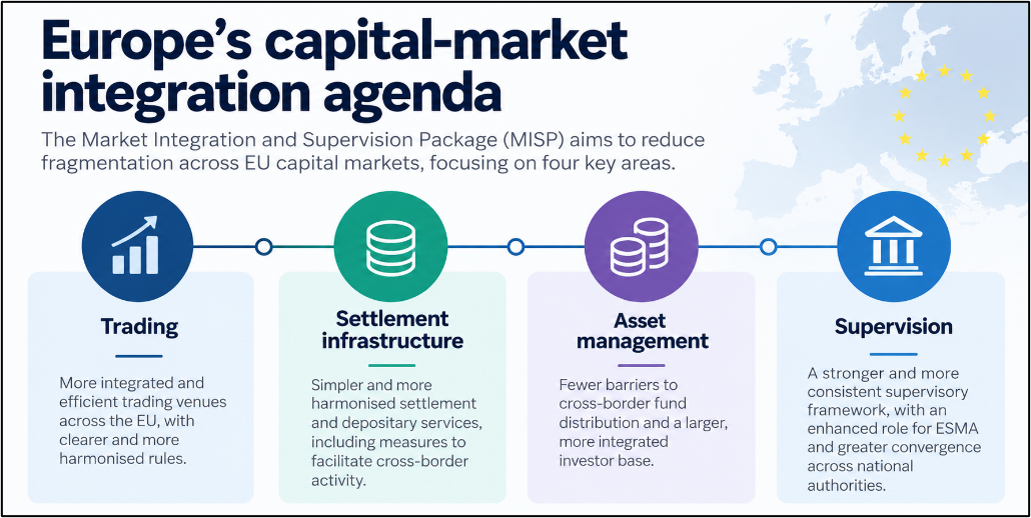
The Council reached a political agreement on 9 October on the key elements of its negotiating position on the Market Integration and Supervision Package (MISP), a central component of the EU's Savings and Investments Union. The package aims to reduce fragmentation across European capital markets, facilitate cross-border investment and strengthen the competitiveness of EU financial markets. 

Under the Council's approach, direct supervision of the most significant cross-border trading venues, central securities depositories (CSDs) and central counterparties (CCPs) would be transferred to the European Securities and Markets Authority (ESMA). The agreement also provides for a new pan-European market operator (PEMO) framework, allowing eligible trading venues to operate across Member States under a single licence and direct ESMA supervision. For crypto-asset service providers, direct EU supervision would be limited to the most significant cross-border operators. 

The Council also agreed on reforms to ESMA's governance, including a new executive board responsible for operational and entity-specific supervisory decisions, while preserving a central role for national supervisors. Other measures include reducing cross-border barriers for asset managers, introducing an optional depositary passport for Member States and expanding the EU's Distributed Ledger Technology (DLT) Pilot Regime. 

The political agreement represents an important step towards the Council's negotiating mandate, although the text still requires finalisation and formal adoption. Negotiations with the European Parliament can begin once Parliament has adopted its own position. 

What this means for CEE markets: Greater supervisory consistency, simpler cross-border procedures and more integrated trading and settlement infrastructure could improve access to investors and financial services for smaller markets. However, the benefits will depend on whether the new framework reduces costs and supports local market development, rather than encouraging further concentration of activity in larger financial centres. The Council's more proportionate approach to direct ESMA supervision and continued involvement of national authorities are particularly relevant for markets with different sizes, structures and levels of development. 
picture1-1791796260.png

Figure 1. Europe's capital-market integration agenda: Four key areas addressed by the Market Integration and Supervision Package (MISP). Source: CEE Perspective illustration, based on the European Commission's MISP proposal and the Council Presidency's October 2026 compromise texts. 

EU financial-services simplification shifts towards banking and investment reform

The European Commission's 2026 progress report on simplification, implementation and enforcement, published on 5 October 2026, sets out ongoing efforts to improve the functioning of the Single Market. For financial services, it points to work on the Savings and Investments Union, Solvency II and supplementary pensions, alongside measures to reduce regulatory complexity and strengthen implementation. 

Looking ahead, the Commission plans further work on banking regulation in early 2027, as well as initiatives covering venture and growth capital, EU Taxonomy reporting and digital finance. The emphasis is shifting beyond reducing individual reporting obligations towards tackling barriers to cross-border activity, improving market access and strengthening competitiveness, while maintaining effective supervision and investor protection. 

What this means for CEE markets: Proportionate implementation and simpler procedures could reduce fixed compliance costs for smaller financial institutions. The practical test will be whether these changes improve access to finance without weakening regulatory clarity or market confidence. 

ESMA clarifies access to third-country securities settlement infrastructure

The European Securities and Markets Authority (ESMA) issued a statement on 7 October addressing uncertainty over EU market participants' access to certain third-country central securities depositories (CSDs). The existing transitional regime is due to expire on 17 January 2027, potentially disrupting cross-border settlement arrangements. 

To avoid regulatory discontinuity, ESMA advised national competent authorities not to prioritise supervisory or enforcement action concerning continued access to the relevant services while EU legislators consider an extension under the Market Integration and Supervision Package (MISP). The intervention highlights the importance of maintaining operational continuity while the EU pursues broader reforms to its market infrastructure. 

What this means for CEE markets: Cross-border securities settlement is important for investors and intermediaries operating in smaller markets. Clear transitional arrangements can help preserve access and operational continuity while permanent rules are negotiated.
CEE Policy Radar

1

Romania: CCP.RO authorisation marks a milestone for domestic market infrastructure

Romania's efforts to strengthen its capital-market infrastructure returned to focus following ESMA's 6 October update to its list of authorised central counterparties. The list includes CCP.RO Bucharest, which received authorisation from Romania's Financial Supervisory Authority in July 2026, marking a significant regulatory milestone for the country's financial markets. 

CCP.RO is intended to support domestic derivatives markets, particularly in equities and energy, by providing central clearing services to manage counterparty risk. While authorisation represents an important step, its contribution to market development will depend on operational readiness, the range of products offered and participation by brokers and institutional investors. 

The next challenge is commercial and operational. A domestic clearing ecosystem will need sufficient transaction volumes, reliable connections to trading venues and sustained market-maker participation if it is to support deeper liquidity and broader derivatives activity. 

Serbia: EBRD approves up to €110.5 million for SME and green financing

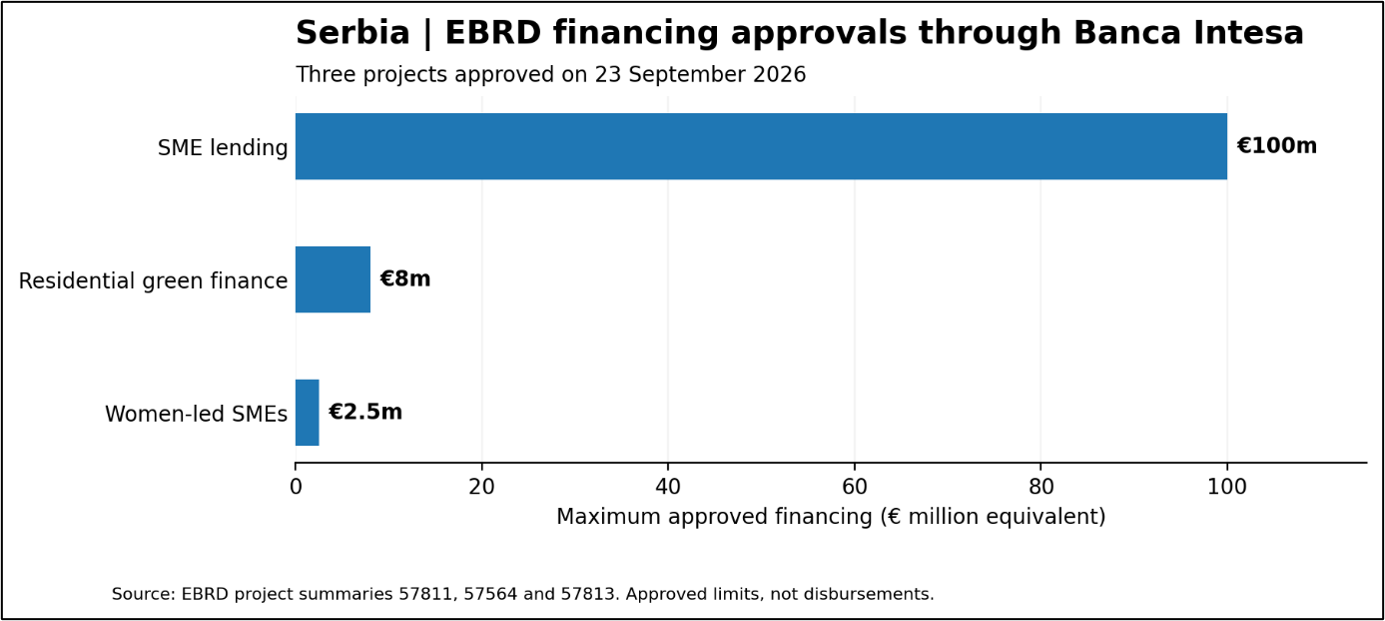
The European Bank for Reconstruction and Development (EBRD) approved three financing projects involving Banca Intesa Belgrade on 23 September, with a combined value of approximately €110.5 million. The largest is a loan of up to €100 million to support lending to Serbian SMEs, including businesses in less-developed regions. Up to 30% of the proceeds are expected to support eligible green investments, particularly renewable energy and energy efficiency. 

Two additional facilities address more targeted financing needs. A €2.5 million loan under the Western Balkans Women in Business Programme will support women-led SMEs, while a loan of up to RSD 940 million (€8 million equivalent) under the Green Economy Financing Facility III will finance residential renewable-energy and energy-efficiency investments.

picture2-1791796345.png

Figure 2. EBRD financing approvals through Banca Intesa Belgrade, September 2026 (€ million equivalent). Figures represent maximum approved financing amounts, not disbursements. Source: CEE Perspective, based on EBRD project summaries 57811, 57564 and 57813. 

The approvals demonstrate how development finance can reach businesses and households through established banking networks. They also complement the EBRD and EU's September risk-sharing initiative, designed to expand lending to underserved Serbian businesses. 

The key measure of success will be additional lending and investment, particularly for borrowers facing financing constraints. The amounts above represent approved project limits, not funds already disbursed to end borrowers. 

Lithuania: €10 million Capitalica bond issue highlights Baltic market financing

Nasdaq Vilnius admitted an additional 2,000 Capitalica European Office Fund bonds to its First North market on 8 October, bringing the total admitted issue to 10,000 bonds with an aggregate nominal value of €10 million. Each bond has a nominal value of €1,000. 

The admission illustrates the role of Baltic capital markets in providing financing alternatives to traditional bank lending. Bond issuance can help businesses and investment vehicles diversify their funding sources while broadening the range of instruments available to investors. However, admission to trading does not automatically ensure active secondary-market liquidity. 

The broader opportunity lies in building a sufficiently diverse issuer and investor base to sustain repeated issuance. Better cross-border access may help, but liquidity and investor confidence ultimately depend on market activity and transparent information. 

Moldova: EBRD backs €127.4 million irrigation modernisation programme

The European Bank for Reconstruction and Development (EBRD) listed the Moldova Sustainable Water Supply project among the approvals at its 7 October Board meeting. According to the project documentation, the programme has an estimated total cost of €127.4 million, including a proposed €102.9 million sovereign loan to rehabilitate and modernise centralised irrigation systems. 

By improving water delivery and reducing losses, the project aims to strengthen the reliability of agricultural production and resilience to drought. The expected benefits will depend on successful implementation, effective operation and farmers' ability to use the upgraded systems. 

The programme is a reminder that competitiveness is not determined by financial-market access alone. For agriculture-dependent economies exposed to climate variability, investment in reliable physical infrastructure can be an important complement to financial-sector development.

This Week's Events to Watch

1
  • 12 October – Foreign Affairs Council: EU foreign ministers meet in Luxembourg to discuss Russia's war against Ukraine, developments in the Middle East and European security, with implications for regional stability and investment confidence across CEE.

  • 12–13 October – Informal meeting of EU telecommunications ministers: Ministers meet to discuss the Digital Networks Act, digital connectivity and the resilience of submarine cable infrastructure. The discussions are relevant to Europe's digital competitiveness and infrastructure investment.

  • 13 October – General Affairs Council: Ministers meet in Luxembourg to discuss the proposed 2028–2034 Multiannual Financial Framework and prepare for the October European Council. The negotiations will be important for future EU funding priorities, including investment and cohesion.

  • 15–16 October – European Council: EU leaders meet in Brussels to discuss competitiveness, Ukraine, the next Multiannual Financial Framework, European defence and security, and other strategic priorities. The discussions will help shape the EU's economic and investment agenda.

CEE Perspective Updates

2

From CEE to the Middle East and North Africa: The lives and livelihoods connecting two regions

What brings Central and Eastern Europeans to the Middle East and North Africa, and how do they build their lives there? On 30 October 2026, from 10:00 to 11:30, CEE Perspective’s Conversations with Experts will explore a migration story less often told. From socialist-era exchanges to contemporary careers and business ventures, the discussion will examine the connections between these regions through the experiences of the people who move between them, including how they work, save and invest.

Drawing on the forthcoming book Central and Eastern European Mobilities to the Middle East and North Africa: Histories, Networks, and Migrant Experiences, we will welcome its editor, Professor Katarzyna Górak-Sosnowska, alongside co-authors Egdūnas Račius, Hanna Smaliichuk and Fabio Coriolano. Fellow co-author Cristina Procházková Ilinitchi will moderate the conversation, examining how historical ties and personal choices shape migration and its economic dimensions. Join us online to hear their findings and put your questions to the authors.

Register here: https://ceeperspective.eu/events/conversations-with-experts-no2

Read more

The second CEE Perspective Academy Conference comes to Prague

Building products, entering foreign markets and keeping more of the value they create: these ambitions will guide the second CEE Perspective Academy Conference, taking place on 4 November 2026 at the Prague University of Economics and Business. Under the theme “From CEE supplier to international competitor,” entrepreneurs, policymakers, financial experts, academics and students will examine how companies from the region can turn their expertise into an international business built around their own products and brands.

International expansion involves difficult choices, and the afternoon’s discussions will address them directly. Keynotes, an entrepreneur’s account of entering a foreign market and a panel on financing and managing expansion will explore market selection, local partnerships and the risks of doing business abroad. Students will then take on those decisions themselves in a practical market-entry exercise, before the launch of the CEE Perspective Student Challenge 2027. We look forward to welcoming you to Prague.

Register here: https://ceeperspective.eu/events/cee-perspective-academy-conference-202

Read more

Also On Our Radar

1
  • EIOPA strengthens supervisory expectations for private equity-backed insurers: On 6 October, EIOPA published a supervisory statement calling for closer scrutiny of governance, ownership structures, investment strategies, related-party transactions and reinsurance arrangements. The guidance seeks to ensure consistent, risk-based supervision as private equity involvement in Europe's insurance sector evolves.

  • AMLA consults on a central EU anti-money-laundering database: On 7 October, the Anti-Money Laundering Authority launched a consultation on draft regulatory technical standards governing its central AML/CFT database. The framework aims to improve the collection and exchange of supervisory information, strengthening coordination and risk assessment across EU jurisdictions.

  • European Parliament clears the way for SFDR trilogues: Following the ECON Committee's decision to enter interinstitutional negotiations, the SFDR review is moving towards trilogues. The proposed reform introduces three sustainability product categories, with significant implications for investment funds, pension products and sustainability-related disclosures.

  • Parliament supports simplification of EU economic-governance rules: MEPs backed changes to align economic and budgetary surveillance procedures with the revised EU fiscal framework, including the removal of overlapping reporting requirements. The simplification initiative is relevant to fiscal oversight, national budget planning and investment priorities across CEE.

  • Commission advances reform of tax-information exchange: The Commission's recast of the Directive on Administrative Cooperation in taxation aims to simplify cross-border tax-information exchange and improve administrative cooperation. The initiative could affect reporting and compliance obligations for financial institutions operating across EU jurisdictions.

  • European Parliament revisits EU corporate-tax policy: In its October plenary session, Parliament adopted recommendations on corporate taxation, addressing EU tax initiatives, international minimum-tax rules and competitiveness. The discussion is particularly relevant for CEE economies seeking to attract investment while preserving competitive business environments.

  • Single Market competitiveness remains in focus ahead of the European Council: EU institutions are preparing for the 15–16 October European Council, with market integration and competitiveness remaining important policy priorities. Progress in reducing cross-border barriers could strengthen investment conditions and opportunities for CEE businesses within European value chains.