EU institutions reaffirm commitment to delivering Single Market reforms by 2027
On 15 October, the presidents of the European Parliament, the Council of the EU and the European Commission reviewed progress under the “One Europe, One Market” roadmap, reaffirming their commitment to advancing key reforms by the end of 2027. The initiative seeks to address persistent barriers to the movement of capital, services, energy and innovation, while reducing administrative burdens and strengthening Europe's competitiveness. The review comes as major elements of the Savings and Investments Union (SIU) agenda, including proposals on market integration and supervision, move through the legislative process.
The European Council's conclusions of 15–16 October further reinforced this agenda, calling for progress on key competitiveness initiatives, including the proposed 28th company-law regime, the Industrial Accelerator Act and the European grids package. Leaders also stressed the need to address high energy prices and advance negotiations on the EU's next long-term budget to ensure funding can begin in 2028.
The renewed commitment highlights the growing importance of implementation. Despite progress towards a more integrated Single Market, differences in national rules, administrative procedures and market practices continue to raise costs for businesses and financial institutions operating across borders. The SIU agenda, the proposed EU Inc. framework and wider simplification efforts address different aspects of these challenges. Their effectiveness will depend not only on legislative agreement but also on coherent implementation and the removal of barriers that persist at national level.
What this means for CEE markets: For smaller and less integrated capital markets, reducing cross-border barriers could make it easier for businesses to access investors, financial intermediaries to expand their services and growing companies to operate across the EU. The real test will be whether the reforms deliver measurable improvements in financing conditions, market access and the availability of growth capital, including for smaller issuers and firms outside Europe's largest financial centres.
European supervisors set 2027 priorities, with digital resilience at the forefront
The European Supervisory Authorities (EBA, EIOPA and ESMA) have published their Joint Committee Work Programme for 2027, setting out shared priorities for financial-sector regulation and supervisory coordination. Digital operational resilience will remain a central focus, alongside sustainable finance, securitisation, consumer protection and the monitoring of emerging financial technologies.
A major area of work will be supporting the implementation of the Digital Operational Resilience Act (DORA) and contributing to its forthcoming review. The authorities expect to provide technical advice to the European Commission in preparation for a potential legislative proposal. This comes as financial institutions continue adapting their ICT risk-management, incident-reporting and third-party oversight arrangements. The programme also envisages further work on innovation-related risks, including artificial intelligence and tokenisation.
Other priorities will depend partly on the progress of ongoing legislative negotiations. Under the review of the Sustainable Finance Disclosure Regulation (SFDR), the authorities may be tasked with developing technical standards to support the revised framework. They will also follow developments in the EU securitisation reform and could undertake additional work on retail-investor disclosures under the PRIIPs framework. Across these areas, supervisory convergence and regulatory simplification remain important objectives.
What this means for CEE markets: Greater consistency in EU supervision could benefit financial institutions operating across smaller and more fragmented markets, particularly where divergent national practices increase compliance costs and complicate cross-border activity. At the same time, the emphasis on digital resilience reflects the growing importance of managing cybersecurity, ICT and technology-provider risks. The practical impact will depend on whether future supervisory requirements improve regulatory clarity and resilience without creating disproportionate burdens for smaller institutions.
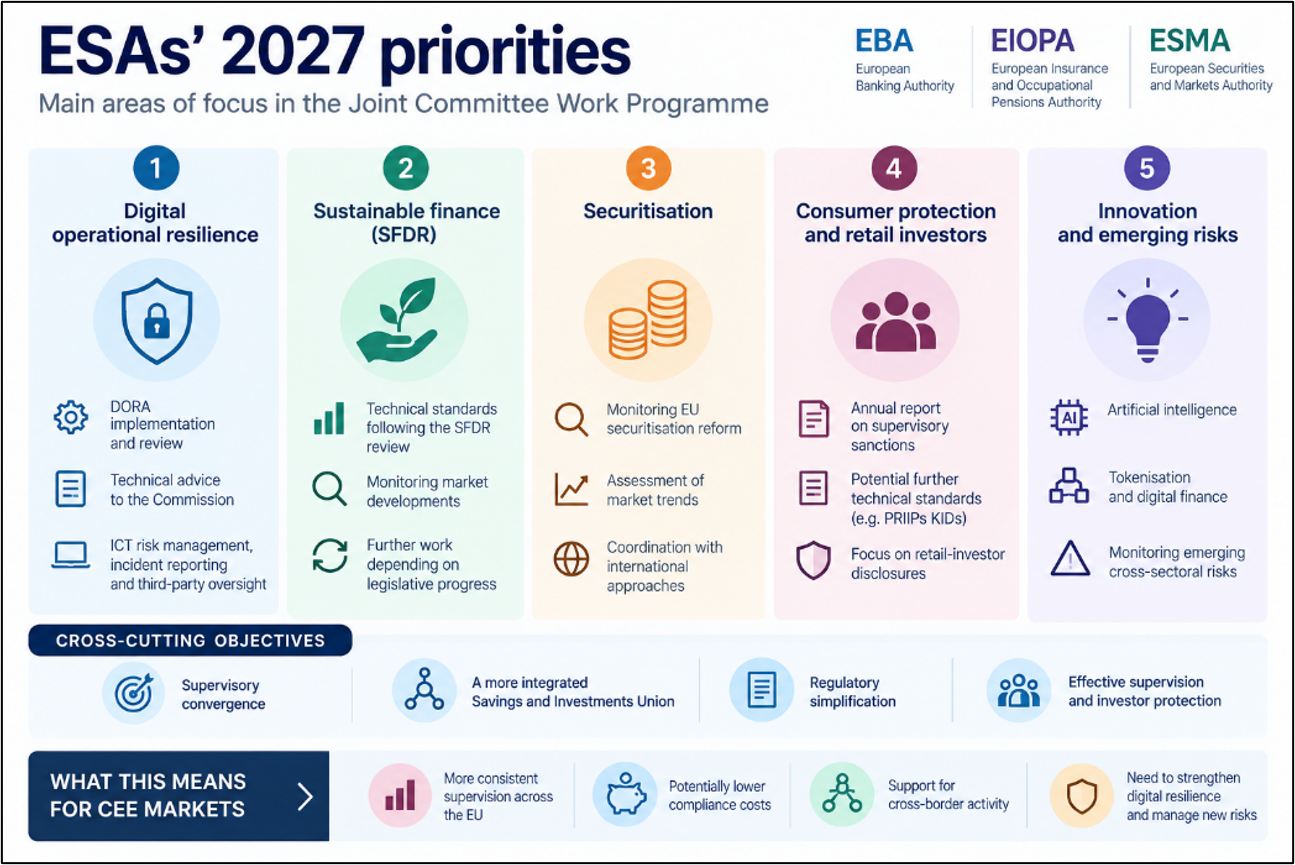
Figure 1. European Supervisory Authorities' priorities for 2027: Key areas of work and potential implications for CEE financial markets. Source: CEE Perspective illustration, based on the ESAs' Joint Committee Annual Work Programme 2027.
EU long-term budget negotiations expose competing investment priorities
EU Member States continued discussions on the next Multiannual Financial Framework (MFF) for 2028–2034 at the General Affairs Council on 13 October. The Irish Presidency's revised negotiating proposal envisages a €1.62 trillion budget for 2028–2034, representing an 8% (€141 billion) reduction compared with the European Commission's initial proposal. The compromise seeks to balance fiscal restraint with continued support for cohesion and agriculture, alongside growing investment needs in competitiveness, research and defence.
The negotiations reflect the challenge of accommodating established investment needs alongside increasing demands for defence, resilience and competitiveness spending. Beyond the headline budget, the design of funding programmes will be equally important. Eligibility conditions, national co-financing requirements and the balance between grants, guarantees and other financial instruments will shape how effectively EU resources support investment and mobilise private capital.
What this means for CEE markets: The outcome will be particularly consequential for CEE economies, where EU funding plays an important role in financing transport and energy infrastructure, regional development, innovation and business investment. Changes to cohesion allocations or programme design could affect countries differently, depending on their investment needs and capacity to absorb funds. Ensuring that EU financing instruments remain accessible to smaller businesses and can effectively complement private investment will be important for supporting the region's competitiveness and long-term economic convergence.