Von der Leyen puts competitiveness, security and investment at the centre of the EU agenda
In her 2026 State of the Union address, Commission President Ursula von der Leyen placed competitiveness, security and greater European independence at the centre of the EU’s agenda. She called for faster implementation of the Draghi and Letta agendas, including deeper Single Market and capital-market integration, lower administrative burdens and measures to address high energy costs. The speech also emphasised investment in defence, energy infrastructure, critical raw materials, AI and strategic connectivity, alongside continued support for Ukraine.
The agenda points towards a stronger focus on mobilising both public and private investment in areas considered strategic for Europe’s economic and security resilience. This includes defence capabilities, electricity grids and generation, industrial capacity and transport links, including stronger connections between Europe, the Black Sea, the South Caucasus and Central Asia.
What this means for CEE markets: Central and Eastern Europe could be particularly exposed to this investment shift given the region’s strategic location and significant needs in defence, energy and infrastructure. Greater EU investment and deeper capital-market integration could support financing opportunities across these sectors, while initiatives such as the Middle Corridor could strengthen the role of countries including Romania and Bulgaria as gateways between the EU and its eastern neighbourhood. The extent of the impact will, however, depend on countries’ ability to mobilise private capital and translate EU priorities into investable projects.
Commission proposes Fair Labour Mobility Package to make cross-border work simpler and more digital
The European Commission adopted its Fair Labour Mobility Package on 15 September, aimed at making it easier for people to work across the EU while improving enforcement of their rights. The package contains five legislative proposals: a European Social Security Pass (ESSPASS); a Skills Portability Act; a strengthened mandate for the European Labour Authority (ELA); amendments to the Professional Qualifications Directive; and common EU rules for recognising qualifications obtained by third-country nationals. This follows the recently concluded revision of the EU social security coordination rules and the e-declaration framework for posted workers.
A major focus is digitalisation and portability. ESSPASS would allow workers to request, store and present documents such as the European Health Insurance Card and portable document A1 digitally through the EU Digital Identity Wallet, while authorities could verify them electronically. The skills proposals would similarly introduce standardised digital qualifications and accelerate recognition procedures for regulated professions, while common rules would make recognition of qualifications obtained outside the EU more predictable. The ELA would meanwhile receive stronger tools for cross-border enforcement, including cooperation on inspections and an expanded role concerning third-country nationals and illegal employment. The Commission estimates that the package could generate around €5 billion in benefits by 2040, including €1 billion in simplification gains.
What this means for CEE markets: The package could be particularly relevant for Central and Eastern Europe, where cross-border labour mobility and persistent skills shortages are important features of many economies. Faster recognition of qualifications and simpler verification of social-security status could reduce administrative costs for businesses recruiting across borders and make it easier for workers to move to where skills are needed. At the same time, stronger ELA enforcement and greater scrutiny of cross-border employment could increase compliance expectations for companies using posted or mobile workers. Over time, easier skills portability could improve labour-market matching across the Single Market, although for CEE economies it may also reinforce existing challenges around outward labour mobility and shortages in some professions.
EU raises €11 billion as common borrowing continues to expand
The European Commission raised €11 billion in EU-Bonds in its eighth syndicated transaction of 2026, issuing a €6 billion three-year bond and a €5 billion 30-year bond. Investor demand was strong, with order books exceeding €72 billion and €80 billion respectively, corresponding to oversubscription of around 12 and 16 times. The transaction forms part of the Commission’s €80 billion funding target for the second half of 2026 and brings total outstanding EU debt to around €849 billion.
The issuance also illustrates the EU’s increasingly established role as a large-scale capital-market borrower. Funds raised through EU-Bonds finance programmes including NextGenerationEU, financial assistance to Ukraine and the SAFE defence instrument. The Commission also highlighted the growing liquidity of the EU-Bond curve, which is increasingly being used as a reference for pricing new issuance rather than relying exclusively on national sovereign benchmarks.
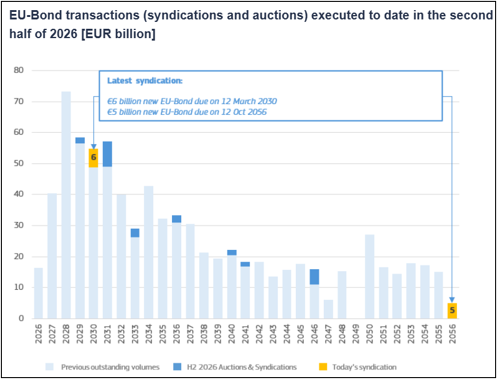
EU-Bond transactions executed in the second half of 2026, by maturity (€ billion)
Source: European Commission, EU as a Borrower, September 2026.
What this means for CEE markets: Continued EU-level borrowing matters for CEE both as a source of financing and for regional capital markets. Several CEE economies are significant beneficiaries of EU investment programmes, while increased financing for defence and security could be particularly relevant for Member States on the EU’s eastern flank. At the same time, a deeper and more liquid EU-Bond market expands the pool of highly rated euro-denominated assets available to banks, pension funds and other institutional investors, potentially supporting the broader development and integration of European capital markets.