CEE Markets & Investment Review - August 2026
Monthly Publication

Monthly intelligence on capital markets, banking, investment and long-term savings across Central and Eastern Europe
Article Content
Introduction
August’s developments point to a CEE region with growing pools of capital, but also to the continuing challenge of translating financial capacity into productive long-term investment. Poland’s move to Developed Market status signals the increasing maturity of the region’s largest equity market, while developments in Poland and Romania show public resources being deployed in different ways to support industrial and energy projects. In Hungary, rapid credit growth has so far been accompanied by stronger demand for short-term financing rather than long-term investment loans.
Pensions and long-term savings add another dimension. Estonia’s pension assets are expanding rapidly but remain overwhelmingly invested abroad, while Czechia is seeking to increase participation and encourage more growth-oriented, long-term investment. Taken together, these developments raise a common question: not only how CEE can mobilise more capital, but whether its markets, institutions and investment opportunities can channel it effectively.
Capital Markets
Poland moves into developed market territory
S&P Dow Jones Indices announced on 20 August that Poland will be reclassified from an Emerging to a Developed market within its global equity country-classification framework. The change will take effect with the September 2027 index reconstitution, giving investors, index users and market-infrastructure providers more than a year to prepare for the transition.
The decision followed S&P DJI’s 2026 country-classification consultation. The provider assesses markets using quantitative and qualitative criteria covering economic conditions, institutional stability, market structure, accessibility, size and liquidity. During the consultation, S&P DJI concluded that Poland’s characteristics met or exceeded its requirements for Developed Market status.
Poland’s domestic equity market has reached considerable scale by regional standards. According to information presented during the consultation, its full domestic market capitalisation amounted to USD 292.2 billion in 2025, while median daily value traded reached USD 363.8 million. These figures place Warsaw substantially ahead of most other capital markets in Central and Eastern Europe and provide a larger investable universe for institutional investors.
Reclassification will change Poland’s position within the S&P global benchmark system. Based on data available in May 2026, Poland represented approximately 1.27% of the S&P DJI Emerging benchmark. S&P estimated that the country would initially account for around 0.15% of its Developed benchmark following the transition. The smaller weight reflects the considerably greater size of the developed-market universe rather than a reduction in the value of the Polish market.
The effect on investment flows is therefore unlikely to be straightforward. Funds following affected emerging-market benchmarks may reduce their Polish holdings when the change is implemented, while developed-market mandates may begin to establish exposure. The long implementation period and Poland’s relatively small estimated weight in the developed-market benchmark mean that the August decision should be treated as a structural change in market positioning rather than as evidence of immediate capital inflows.
The classification is also specific to S&P DJI and does not automatically change Poland’s status within benchmarks maintained by other index providers. Its practical significance will depend on the indices affected, the amount of capital tracking those indices and the response of active and passive fund managers. Over the longer term, the benefits will also depend on Poland’s ability to maintain market accessibility, liquidity, institutional stability and a sufficiently broad pipeline of investable companies.
CEE Perspective analysis
Poland’s reclassification provides further evidence that the region’s largest capital market is moving beyond CEE’s traditional emerging-market position. Developed status may broaden Poland’s visibility among international institutions and strengthen its role within European investment portfolios. It may also reinforce incentives to improve trading infrastructure, corporate governance and the availability of listed securities.
At the same time, Poland’s experience should not be interpreted as evidence of uniform capital-market convergence across CEE. Warsaw’s scale and liquidity remain difficult for smaller regional exchanges to reproduce, while a classification change does not itself create new issuers, deeper free float or sustained investor participation. The key question is whether the new status ultimately supports a broader investor base and whether Poland’s progress encourages further market development elsewhere in the region.
Banking and Monetary Conditions
Hungary's Q2 lending: corporate and household credit continue to grow
The Magyar Nemzeti Bank reportedon 28 August that the corporate loan portfolio increased by 11.5% year-on-year to June 2026, above the regional average of 8.8% and the EU average of 4.1%. SME lending also grew by 11.1%. However, the quarterly value of new corporate loan contracts was around 30% lower year-on-year. Demand increased in Q2, particularly for short-term financing of inventories and receivables, while a net 16% of banks reported weaker demand for long-term loans. Lending conditions remained broadly unchanged. Looking ahead, a net 19% of banks expect long-term loan demand to increase in H2, driven by investment needs and lower interest rates.
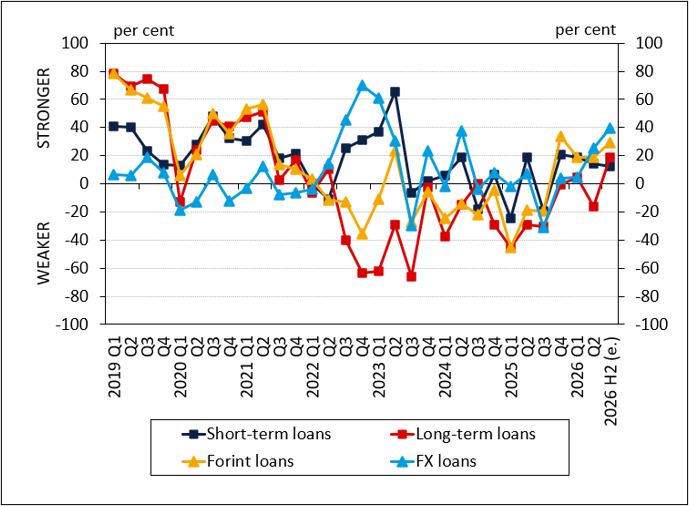
Figure 1. Change in corporate credit demand by maturity and denomination, Hungary |Note: Positive values indicate stronger demand and negative values weaker demand. H2 2026 figures represent banks’ expectations. |Source: Magyar Nemzeti Bank (MNB), Lending Survey, Q2 2026.
Household lending grew by 19.6% year-on-year, also well above the regional average of 8.2% and the EU average of 3.2%. Growth was mainly driven by housing loans, including the Home Start Programme, and personal loans. By mid-August, HUF 2,000 billion of Home Start loan contracts had been concluded, covering 56,000 contracts. While a net one-third of banks reported weaker demand for housing loans, consumer loan demand increased according to a net 80% of banks.
CEE Perspective analysis
Hungary's strong lending growth highlights an important distinction between the growth of credit and the type of financing being demanded. Corporate lending is growing significantly faster than in both the CEE region and the EU, but in Q2 demand was stronger for short-term financing, while demand for long-term loans weakened. As lending conditions remained broadly unchanged, the key question is whether lower interest rates and rising investment needs will translate into stronger demand for long-term investment financing.
If this materialises in the second half of the year, strong credit growth could increasingly support productive investment. If not, it would suggest that strong headline lending growth does not necessarily translate into stronger corporate investment. Hungary's experience therefore illustrates a broader CEE challenge: ensuring that expanding financial resources translate into financing for productive, long-term investment.
Investments
Romania combines public risk-sharing and commercial finance for solar and storage
A consortium of six international lenders signed a financing package of up to €229 million in August for Econergy’s Părău 2 project in Brașov County. The project will combine 342 MW of solar capacity with a 150 MW/300 MWh battery-storage system. The European Bank for Reconstruction and Development will provide up to €120 million, alongside financing from the Black Sea Trade and Development Bank, OTP Bank, Exim Banca Românească and other participating commercial banks.
The financing structure combines development-bank lending, commercial debt and public risk-sharing. An InvestEU first-loss guarantee will cover up to €115 million of the EBRD financing, helping to mitigate risks arising from the project’s exposure to market-based electricity revenues. A 125 MW portion of the solar plant has also secured a 15-year contract for difference at a strike price of €49.4 per MWh, while the remaining capacity will operate on a merchant basis.
Combining solar generation with battery storage should allow the project to shift part of its output towards periods of higher demand and provide balancing services to the Romanian electricity system. Părău 2 is also the first hybrid solar-and-storage project financed by the EBRD in Romania. However, the August agreement represents a financing milestone rather than the completion of the investment: construction, grid connection and battery integration will determine whether the project enters commercial operation as planned.
Poland deploys public equity for industrial investment
Poland’s National Fund for Environmental Protection and Water Management became the majority shareholder in ElectroMobility Poland in August after subscribing for shares and transferring nearly PLN 4.5 billion to the company. The financing comes from Poland’s Recovery and Resilience Plan and is intended to support the development of the Polish Electromobility Hub in Jaworzno.
The planned investment combines an electric-vehicle factory with engineering and research facilities. Implementation is scheduled for 2026-2030, with production expected to begin in 2029. The project is intended to involve cooperation with Foxconn and Foxtron Vehicle Technologies, while approximately 70% of the value of components is expected to come from EU suppliers once production begins, including a significant Polish contribution.
The transfer represents a more concrete investment milestone than the agreements announced earlier in the year because capital has entered the company and the ownership structure has changed. Nevertheless, significant implementation risks remain. The project’s longer-term contribution will depend on final partnership arrangements, factory construction, product development, procurement discipline and the ability to establish a commercially viable position in the European electric-vehicle market.
CEE Perspective analysis
The Romanian and Polish investments illustrate two different approaches to deploying public resources. Părău 2 uses guarantees and revenue stabilisation to mobilise commercial lenders around a privately developed project, while Poland is providing equity directly to a strategic industrial company and assuming a larger share of the project risk.
Both approaches may have wider relevance for CEE, where investment requirements remain substantial but public resources are limited. Their success will depend not only on the availability of financing, but on whether public support attracts additional private capital, strengthens regional supply chains and results in commercially viable operating assets.
Pensions and long-term savings
Estonia's fund assets fise Sharply, but Pension capital remains predominantly invested abroad
Estonia’s investment and pension fund assets reached €11.8 billion at the end of Q2 2026, up 24% year-on-year, according to Eesti Pank. Pension funds accounted for the large majority, with second- and third-pillar assets reaching €9.08 billion. Second-pillar assets rose 28% to €7.74 billion, while third-pillar assets increased 45% to €1.34 billion. Much of the increase reflected rising investment values, with second- and third-pillar funds recording average nominal annual returns of 22% and 24%, respectively.
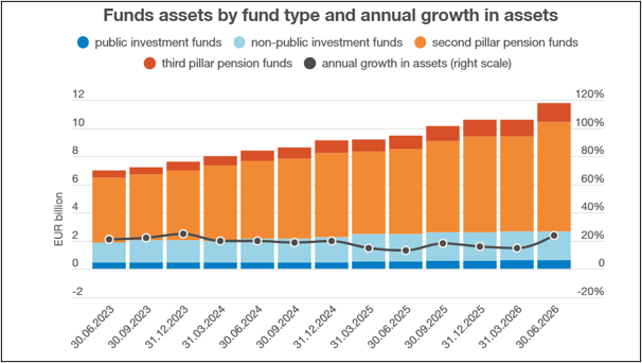
Figure 2. Assets of Estonian investment and pension funds by fund type and annual asset growth, Q2 2023–Q2 2026. | Source: Eesti Pank, Statistics on investment and pension funds, Q2 2026, 11 August 2026.
The figures also point to a growing role for index-based investing. Index funds accounted for 35% of second-pillar assets and 62% of third-pillar assets. At the same time, only 9% of second-pillar and 3% of third-pillar investments were invested in Estonia, with both shares declining over the previous year. Estonia therefore has a rapidly growing pool of long-term household savings, but only a limited share is currently channelled into the domestic economy.
Czechia advances reform of supplementary pension savings
The Czech government has approved amendments to the Act on Supplementary Pension Savings, with the legislation now moving to the Chamber of Deputies. Proposed to enter into force on 1 January 2027, the reforms aim to encourage longer-term saving in the third pension pillar. The package would abolish the fee charged on the appreciation of savings, cap management fees at 0.5%, introduce a life-cycle investment strategy as the default option, strengthen state support for younger savers, and provide for the closure of underperforming transformed funds in 2036. Under the proposed life-cycle approach, investment allocation would adjust according to the saver’s age, with clients under 50 required to hold at least 75% of their portfolio in dynamic investments.
The reform would also encourage earlier participation in supplementary pension saving. For savers under 18, the minimum monthly contribution eligible for a state contribution would be reduced to CZK 100, while for savers up to their 30th birthday, the state contribution would be doubled to 40% of their monthly contribution. In addition, clients would be able, after at least ten years of saving and before reaching 36, to withdraw up to one-third of their own contributions and returns without penalty while continuing to save with the remaining balance. A proposed mandatory pension offer for new employees was not included following a lack of agreement with employer representatives.
CEE Perspective analysis
Taken together, Estonia and Czechia illustrate two sides of the challenge of mobilising pension savings for long-term investment in CEE. Czechia is seeking to strengthen the accumulation side by encouraging earlier participation, lowering fees and introducing a life-cycle approach that could increase savers’ exposure to growth assets. Estonia, meanwhile, shows that even a rapidly expanding pool of pension capital does not necessarily translate into greater financing for the domestic economy: pension assets are increasingly invested through index funds and remain predominantly allocated abroad.
The broader lesson is that increasing household savings is only one part of the equation. Pension systems need to deliver appropriate diversification and returns for savers, while domestic and regional capital markets need to offer sufficiently attractive investment opportunities if a greater share of long-term savings is to finance European companies and productive investment. This distinction is particularly relevant to the Savings and Investments Union: expanding the pool of investable savings and developing the markets capable of absorbing that capital are complementary, but separate, policy challenges.
Regional dashboard
Country | August Development | Market Implication |
Poland | S&P reclassified Poland as Developed; nearly PLN 4.5bn transferred to ElectroMobility Poland | Stronger global market recognition alongside expanded strategic public investment |
Hungary | Corporate and household lending grew by 11.5% and 19.6% year on year | Rapid credit expansion, but long-term investment demand remains comparatively weak |
Romania | €229m financing secured for the Părău 2 solar and battery project | Blended finance supporting renewable capacity, with implementation now the central test |
Czechia | Government approved reforms to supplementary pension savings | Greater participation and more growth-oriented allocation of long-term savings |
Estonia | Pension assets increased sharply, while domestic investment shares declined | Savings growth is not yet translating into deeper domestic capital markets |
6 Signals from August
1) Market recognition remains uneven: Poland reached Developed status, while smaller CEE markets remain less visible.
2) Credit growth is outrunning long-term investment demand: Hungary’s corporate and household lending both grew well above the CEE and EU averages, but new long-term corporate loan contracts fell even as short-term financing rose.
3) Blended finance is moving projects forward: Public risk-sharing helped mobilise commercial financing for Părău 2.
4) Public capital is assuming industrial risk: Poland used direct equity to support its electromobility ambitions.
5) Pension savings are growing faster than their domestic footprint: Estonia's fund assets rose 24% y/y, but only 9% of second-pillar and 3% of third-pillar assets are invested domestically, and both shares are shrinking, growth in savings isn't translating into regional capital deepening.
6) Czechia’s pension reform targets both participation and investment quality at once: It doubles state contributions for under-30 savers and lowers the entry threshold for under-18s, while introducing a life-cycle default strategy and capping fees to improve how existing savings are invested. The reform therefore tests whether policymakers can expand the savings pool and improve its allocation simultaneously, rather than treating the two as sequential challenges.
What to watch next
Poland: Attention will turn to the implementation of Poland’s two August developments. S&P DJI will identify the indices affected ahead of the September 2027 reclassification, while ElectroMobility Poland will need to convert its new public equity into binding partnerships, construction progress and a commercially credible production plan.
Hungary: Long-term loan demand is excepted in H2 of 2026, driven by lower interest rates. Attention will turn to whether the above would be translated into investment financing rather than short-term working-capital lending in Q3 and Q4.
Romania: The next stage of the Părău 2 project will depend on financing drawdown, construction and grid-connection progress. Delivery against the planned timetable will determine whether the financing structure can provide a replicable model for hybrid renewable-energy investment elsewhere in CEE.
Estonia: Q3 fund-asset data will show whether the shrinking domestic-investment share of pension assets (9% second pillar, 3% third pillar) keeps falling, and whether any new domestic investment vehicles emerge to compete for a larger slice of the growing pension pool.
Czechia: The amendments now move to the Chamber of Deputies, with parliamentary progress expected through autumn ahead of the planned 1 January 2027 entry into force. Longer term, participation among younger savers and changes in pension-fund asset allocation will indicate whether the reform strengthens supplementary pensions as a source of long-term capital.
Region-wide: The closure of the Recovery and Resilience Facility will become an immediate test of investment execution across CEE. All milestones had to be completed by 31 August, final payment requests must be submitted by 30 September, and the Commission must make the remaining payments by 31 December, with no further disbursements possible in 2027. Attention will turn to whether countries secure their outstanding funds and whether domestic capital markets, banks and other EU instruments can sustain investment once exceptional RRF financing ends.
Article Content
Introduction
August’s developments point to a CEE region with growing pools of capital, but also to the continuing challenge of translating financial capacity into productive long-term investment. Poland’s move to Developed Market status signals the increasing maturity of the region’s largest equity market, while developments in Poland and Romania show public resources being deployed in different ways to support industrial and energy projects. In Hungary, rapid credit growth has so far been accompanied by stronger demand for short-term financing rather than long-term investment loans.
Pensions and long-term savings add another dimension. Estonia’s pension assets are expanding rapidly but remain overwhelmingly invested abroad, while Czechia is seeking to increase participation and encourage more growth-oriented, long-term investment. Taken together, these developments raise a common question: not only how CEE can mobilise more capital, but whether its markets, institutions and investment opportunities can channel it effectively.
Capital Markets
Poland moves into developed market territory
S&P Dow Jones Indices announced on 20 August that Poland will be reclassified from an Emerging to a Developed market within its global equity country-classification framework. The change will take effect with the September 2027 index reconstitution, giving investors, index users and market-infrastructure providers more than a year to prepare for the transition.
The decision followed S&P DJI’s 2026 country-classification consultation. The provider assesses markets using quantitative and qualitative criteria covering economic conditions, institutional stability, market structure, accessibility, size and liquidity. During the consultation, S&P DJI concluded that Poland’s characteristics met or exceeded its requirements for Developed Market status.
Poland’s domestic equity market has reached considerable scale by regional standards. According to information presented during the consultation, its full domestic market capitalisation amounted to USD 292.2 billion in 2025, while median daily value traded reached USD 363.8 million. These figures place Warsaw substantially ahead of most other capital markets in Central and Eastern Europe and provide a larger investable universe for institutional investors.
Reclassification will change Poland’s position within the S&P global benchmark system. Based on data available in May 2026, Poland represented approximately 1.27% of the S&P DJI Emerging benchmark. S&P estimated that the country would initially account for around 0.15% of its Developed benchmark following the transition. The smaller weight reflects the considerably greater size of the developed-market universe rather than a reduction in the value of the Polish market.
The effect on investment flows is therefore unlikely to be straightforward. Funds following affected emerging-market benchmarks may reduce their Polish holdings when the change is implemented, while developed-market mandates may begin to establish exposure. The long implementation period and Poland’s relatively small estimated weight in the developed-market benchmark mean that the August decision should be treated as a structural change in market positioning rather than as evidence of immediate capital inflows.
The classification is also specific to S&P DJI and does not automatically change Poland’s status within benchmarks maintained by other index providers. Its practical significance will depend on the indices affected, the amount of capital tracking those indices and the response of active and passive fund managers. Over the longer term, the benefits will also depend on Poland’s ability to maintain market accessibility, liquidity, institutional stability and a sufficiently broad pipeline of investable companies.
CEE Perspective analysis
Poland’s reclassification provides further evidence that the region’s largest capital market is moving beyond CEE’s traditional emerging-market position. Developed status may broaden Poland’s visibility among international institutions and strengthen its role within European investment portfolios. It may also reinforce incentives to improve trading infrastructure, corporate governance and the availability of listed securities.
At the same time, Poland’s experience should not be interpreted as evidence of uniform capital-market convergence across CEE. Warsaw’s scale and liquidity remain difficult for smaller regional exchanges to reproduce, while a classification change does not itself create new issuers, deeper free float or sustained investor participation. The key question is whether the new status ultimately supports a broader investor base and whether Poland’s progress encourages further market development elsewhere in the region.
Banking and Monetary Conditions
Hungary's Q2 lending: corporate and household credit continue to grow
The Magyar Nemzeti Bank reportedon 28 August that the corporate loan portfolio increased by 11.5% year-on-year to June 2026, above the regional average of 8.8% and the EU average of 4.1%. SME lending also grew by 11.1%. However, the quarterly value of new corporate loan contracts was around 30% lower year-on-year. Demand increased in Q2, particularly for short-term financing of inventories and receivables, while a net 16% of banks reported weaker demand for long-term loans. Lending conditions remained broadly unchanged. Looking ahead, a net 19% of banks expect long-term loan demand to increase in H2, driven by investment needs and lower interest rates.
Figure 1. Change in corporate credit demand by maturity and denomination, Hungary |Note: Positive values indicate stronger demand and negative values weaker demand. H2 2026 figures represent banks’ expectations. |Source: Magyar Nemzeti Bank (MNB), Lending Survey, Q2 2026.
Household lending grew by 19.6% year-on-year, also well above the regional average of 8.2% and the EU average of 3.2%. Growth was mainly driven by housing loans, including the Home Start Programme, and personal loans. By mid-August, HUF 2,000 billion of Home Start loan contracts had been concluded, covering 56,000 contracts. While a net one-third of banks reported weaker demand for housing loans, consumer loan demand increased according to a net 80% of banks.
CEE Perspective analysis
Hungary's strong lending growth highlights an important distinction between the growth of credit and the type of financing being demanded. Corporate lending is growing significantly faster than in both the CEE region and the EU, but in Q2 demand was stronger for short-term financing, while demand for long-term loans weakened. As lending conditions remained broadly unchanged, the key question is whether lower interest rates and rising investment needs will translate into stronger demand for long-term investment financing.
If this materialises in the second half of the year, strong credit growth could increasingly support productive investment. If not, it would suggest that strong headline lending growth does not necessarily translate into stronger corporate investment. Hungary's experience therefore illustrates a broader CEE challenge: ensuring that expanding financial resources translate into financing for productive, long-term investment.
Investments
Romania combines public risk-sharing and commercial finance for solar and storage
A consortium of six international lenders signed a financing package of up to €229 million in August for Econergy’s Părău 2 project in Brașov County. The project will combine 342 MW of solar capacity with a 150 MW/300 MWh battery-storage system. The European Bank for Reconstruction and Development will provide up to €120 million, alongside financing from the Black Sea Trade and Development Bank, OTP Bank, Exim Banca Românească and other participating commercial banks.
The financing structure combines development-bank lending, commercial debt and public risk-sharing. An InvestEU first-loss guarantee will cover up to €115 million of the EBRD financing, helping to mitigate risks arising from the project’s exposure to market-based electricity revenues. A 125 MW portion of the solar plant has also secured a 15-year contract for difference at a strike price of €49.4 per MWh, while the remaining capacity will operate on a merchant basis.
Combining solar generation with battery storage should allow the project to shift part of its output towards periods of higher demand and provide balancing services to the Romanian electricity system. Părău 2 is also the first hybrid solar-and-storage project financed by the EBRD in Romania. However, the August agreement represents a financing milestone rather than the completion of the investment: construction, grid connection and battery integration will determine whether the project enters commercial operation as planned.
Poland deploys public equity for industrial investment
Poland’s National Fund for Environmental Protection and Water Management became the majority shareholder in ElectroMobility Poland in August after subscribing for shares and transferring nearly PLN 4.5 billion to the company. The financing comes from Poland’s Recovery and Resilience Plan and is intended to support the development of the Polish Electromobility Hub in Jaworzno.
The planned investment combines an electric-vehicle factory with engineering and research facilities. Implementation is scheduled for 2026-2030, with production expected to begin in 2029. The project is intended to involve cooperation with Foxconn and Foxtron Vehicle Technologies, while approximately 70% of the value of components is expected to come from EU suppliers once production begins, including a significant Polish contribution.
The transfer represents a more concrete investment milestone than the agreements announced earlier in the year because capital has entered the company and the ownership structure has changed. Nevertheless, significant implementation risks remain. The project’s longer-term contribution will depend on final partnership arrangements, factory construction, product development, procurement discipline and the ability to establish a commercially viable position in the European electric-vehicle market.
CEE Perspective analysis
The Romanian and Polish investments illustrate two different approaches to deploying public resources. Părău 2 uses guarantees and revenue stabilisation to mobilise commercial lenders around a privately developed project, while Poland is providing equity directly to a strategic industrial company and assuming a larger share of the project risk.
Both approaches may have wider relevance for CEE, where investment requirements remain substantial but public resources are limited. Their success will depend not only on the availability of financing, but on whether public support attracts additional private capital, strengthens regional supply chains and results in commercially viable operating assets.
Pensions and long-term savings
Estonia's fund assets fise Sharply, but Pension capital remains predominantly invested abroad
Estonia’s investment and pension fund assets reached €11.8 billion at the end of Q2 2026, up 24% year-on-year, according to Eesti Pank. Pension funds accounted for the large majority, with second- and third-pillar assets reaching €9.08 billion. Second-pillar assets rose 28% to €7.74 billion, while third-pillar assets increased 45% to €1.34 billion. Much of the increase reflected rising investment values, with second- and third-pillar funds recording average nominal annual returns of 22% and 24%, respectively.
Figure 2. Assets of Estonian investment and pension funds by fund type and annual asset growth, Q2 2023–Q2 2026. | Source: Eesti Pank, Statistics on investment and pension funds, Q2 2026, 11 August 2026.
The figures also point to a growing role for index-based investing. Index funds accounted for 35% of second-pillar assets and 62% of third-pillar assets. At the same time, only 9% of second-pillar and 3% of third-pillar investments were invested in Estonia, with both shares declining over the previous year. Estonia therefore has a rapidly growing pool of long-term household savings, but only a limited share is currently channelled into the domestic economy.
Czechia advances reform of supplementary pension savings
The Czech government has approved amendments to the Act on Supplementary Pension Savings, with the legislation now moving to the Chamber of Deputies. Proposed to enter into force on 1 January 2027, the reforms aim to encourage longer-term saving in the third pension pillar. The package would abolish the fee charged on the appreciation of savings, cap management fees at 0.5%, introduce a life-cycle investment strategy as the default option, strengthen state support for younger savers, and provide for the closure of underperforming transformed funds in 2036. Under the proposed life-cycle approach, investment allocation would adjust according to the saver’s age, with clients under 50 required to hold at least 75% of their portfolio in dynamic investments.
The reform would also encourage earlier participation in supplementary pension saving. For savers under 18, the minimum monthly contribution eligible for a state contribution would be reduced to CZK 100, while for savers up to their 30th birthday, the state contribution would be doubled to 40% of their monthly contribution. In addition, clients would be able, after at least ten years of saving and before reaching 36, to withdraw up to one-third of their own contributions and returns without penalty while continuing to save with the remaining balance. A proposed mandatory pension offer for new employees was not included following a lack of agreement with employer representatives.
CEE Perspective analysis
Taken together, Estonia and Czechia illustrate two sides of the challenge of mobilising pension savings for long-term investment in CEE. Czechia is seeking to strengthen the accumulation side by encouraging earlier participation, lowering fees and introducing a life-cycle approach that could increase savers’ exposure to growth assets. Estonia, meanwhile, shows that even a rapidly expanding pool of pension capital does not necessarily translate into greater financing for the domestic economy: pension assets are increasingly invested through index funds and remain predominantly allocated abroad.
The broader lesson is that increasing household savings is only one part of the equation. Pension systems need to deliver appropriate diversification and returns for savers, while domestic and regional capital markets need to offer sufficiently attractive investment opportunities if a greater share of long-term savings is to finance European companies and productive investment. This distinction is particularly relevant to the Savings and Investments Union: expanding the pool of investable savings and developing the markets capable of absorbing that capital are complementary, but separate, policy challenges.
Regional dashboard
Country | August Development | Market Implication |
Poland | S&P reclassified Poland as Developed; nearly PLN 4.5bn transferred to ElectroMobility Poland | Stronger global market recognition alongside expanded strategic public investment |
Hungary | Corporate and household lending grew by 11.5% and 19.6% year on year | Rapid credit expansion, but long-term investment demand remains comparatively weak |
Romania | €229m financing secured for the Părău 2 solar and battery project | Blended finance supporting renewable capacity, with implementation now the central test |
Czechia | Government approved reforms to supplementary pension savings | Greater participation and more growth-oriented allocation of long-term savings |
Estonia | Pension assets increased sharply, while domestic investment shares declined | Savings growth is not yet translating into deeper domestic capital markets |
6 Signals from August
1) Market recognition remains uneven: Poland reached Developed status, while smaller CEE markets remain less visible.
2) Credit growth is outrunning long-term investment demand: Hungary’s corporate and household lending both grew well above the CEE and EU averages, but new long-term corporate loan contracts fell even as short-term financing rose.
3) Blended finance is moving projects forward: Public risk-sharing helped mobilise commercial financing for Părău 2.
4) Public capital is assuming industrial risk: Poland used direct equity to support its electromobility ambitions.
5) Pension savings are growing faster than their domestic footprint: Estonia's fund assets rose 24% y/y, but only 9% of second-pillar and 3% of third-pillar assets are invested domestically, and both shares are shrinking, growth in savings isn't translating into regional capital deepening.
6) Czechia’s pension reform targets both participation and investment quality at once: It doubles state contributions for under-30 savers and lowers the entry threshold for under-18s, while introducing a life-cycle default strategy and capping fees to improve how existing savings are invested. The reform therefore tests whether policymakers can expand the savings pool and improve its allocation simultaneously, rather than treating the two as sequential challenges.
What to watch next
Poland: Attention will turn to the implementation of Poland’s two August developments. S&P DJI will identify the indices affected ahead of the September 2027 reclassification, while ElectroMobility Poland will need to convert its new public equity into binding partnerships, construction progress and a commercially credible production plan.
Hungary: Long-term loan demand is excepted in H2 of 2026, driven by lower interest rates. Attention will turn to whether the above would be translated into investment financing rather than short-term working-capital lending in Q3 and Q4.
Romania: The next stage of the Părău 2 project will depend on financing drawdown, construction and grid-connection progress. Delivery against the planned timetable will determine whether the financing structure can provide a replicable model for hybrid renewable-energy investment elsewhere in CEE.
Estonia: Q3 fund-asset data will show whether the shrinking domestic-investment share of pension assets (9% second pillar, 3% third pillar) keeps falling, and whether any new domestic investment vehicles emerge to compete for a larger slice of the growing pension pool.
Czechia: The amendments now move to the Chamber of Deputies, with parliamentary progress expected through autumn ahead of the planned 1 January 2027 entry into force. Longer term, participation among younger savers and changes in pension-fund asset allocation will indicate whether the reform strengthens supplementary pensions as a source of long-term capital.
Region-wide: The closure of the Recovery and Resilience Facility will become an immediate test of investment execution across CEE. All milestones had to be completed by 31 August, final payment requests must be submitted by 30 September, and the Commission must make the remaining payments by 31 December, with no further disbursements possible in 2027. Attention will turn to whether countries secure their outstanding funds and whether domestic capital markets, banks and other EU instruments can sustain investment once exceptional RRF financing ends.