
Newsletter • 14 September 2026

CEE Perspective Weekly Digest- Issue 14

CEE Perspective Weekly Digest- Issue 14

What's on the table this week

This week’s developments show a single external shock producing very different outcomes, and very different policy responses, across Central and Eastern Europe. 

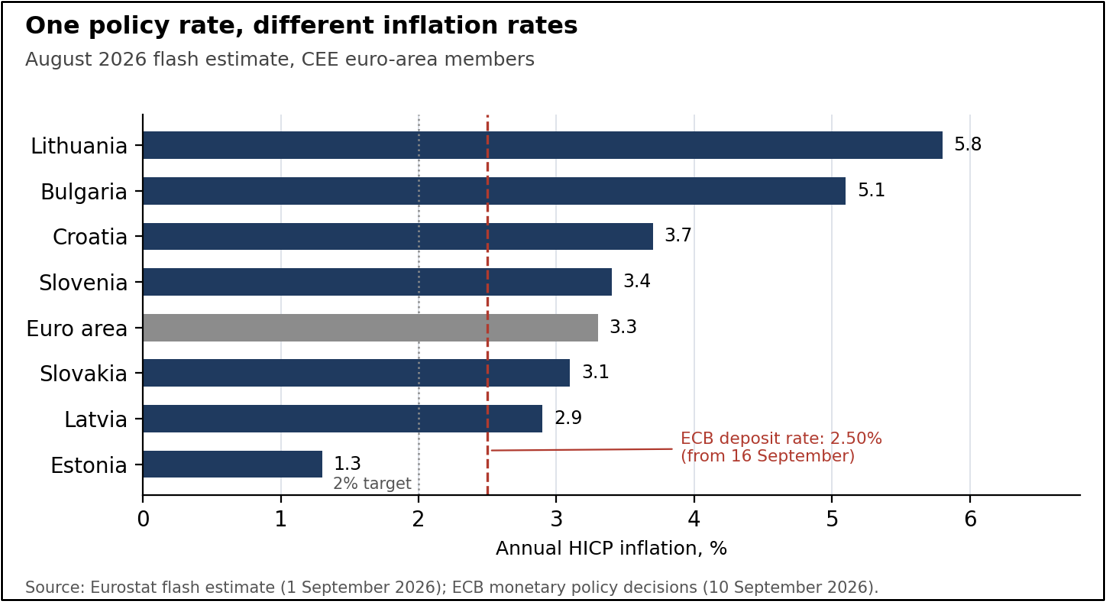
The ECB raised its key interest rates by 25 basis points as the conflict in the Middle East continues to push energy prices and inflation higher. Yet within the euro area, August inflation ranged from 1.3% in Estonia to 5.8% in Lithuania, meaning the same policy rate is landing on very different national conditions. Outside the euro area, Poland kept rates on hold as inflation moved towards the top of the NBP’s tolerance band, the Czech National Bank warned that a further increase in its countercyclical capital buffer has become more likely, and Hungarian inflation remained well below target. 

The growth data tell a similar story. Second-quarter figures published this week show Slovenia growing by almost 5% while Romania’s economy was 2% smaller than a year earlier, even as Romanian investment continued to expand strongly. 

On the regulatory side, Parliament’s position on the SFDR review and ESMA’s latest Listing Act package both raise a question that recurs for smaller markets: how rules designed with deep, mature capital markets in mind will work in CEE. Across all of these developments, the regional average is becoming an increasingly unreliable guide.

Recent Key EU Developments

1

ECB raises rates as energy prices keep inflation above target

The ECB Governing Council raised its three key interest rates by 25 basis points on 10 September, taking the deposit facility rate to 2.50%, the main refinancing operations rate to 2.65% and the marginal lending facility rate to 2.90% with effect from 16 September. The Council said that the conflict in the Middle East continues to generate inflation pressures and that inflation is set to remain well above target for an extended period.
picture1-1789376759.png

Same policy rate, different inflation: annual HICP inflation in CEE euro-area members, August 2026 flash estimate. Source: Eurostat; ECB. 

The new staff projections see headline inflation averaging 3.0% in 2026, 2.5% in 2027 and 2.1% in 2028, with the figures for 2027 and 2028 revised up since June. Growth projections were revised up to 0.9% for 2026 and 1.4% for 2027, reflecting the greater-than-expected resilience of the euro-area economy, with 1.5% expected in 2028. The Council retained its data-dependent, meeting-by-meeting approach and said it is not pre-committing to a particular rate path. 

Energy remains the main driver. Eurostat’s flash estimate put euro-area inflation at 3.3% in August, up from 2.9% in July, with energy prices 14.3% higher than a year earlier. Inflation excluding energy, food, alcohol and tobacco was 2.4%. 

What this means for CEE markets: For the seven CEE members of the euro area, the rate increase tightens financing conditions uniformly, but inflation does not move uniformly. Lithuania (5.8%) and Bulgaria (5.1%) face inflation more than twice the ECB’s new deposit rate, so real policy rates remain negative there even after the hike, while in Estonia (1.3%) the same move amounts to a meaningful real tightening. For non-euro CEE economies, the ECB’s decision shifts the external reference point: with policy rates unchanged in Warsaw, interest-rate differentials with the euro area narrow. How central banks in Warsaw, Prague and Budapest respond over the coming months will shape borrowing costs for households and companies across the region. 

Parliament sets its position on the SFDR review, opening the way to trilogues

The European Parliament’s ECON Committee adopted its position on the review of the Sustainable Finance Disclosure Regulation on 10 September, by 37 votes to 9 with 4 abstentions. The negotiating mandate is due to be announced at the start of the October I plenary session, after which negotiations can begin with the Council, which agreed its own position on 24 June. 

MEPs backed the Commission’s proposal to replace the current disclosure-based approach with three standard product categories (sustainable, transition and ESG basics), each of which would have to disclose its investments’ principal adverse impacts on sustainability. The most contested issue was the treatment of fossil fuels in the transition category. Under the committee’s position, companies expanding fossil-fuel production could be included only if at least 20% of their annual investment is directed towards Taxonomy-aligned activities and if, over a rolling three-year period, they invest more in green activities than in new fossil-fuel projects. Firms would also need due-diligence and monitoring processes for categorised products, reviewed at least once a year. 

Rapporteur Gerben-Jan Gerbrandy (Renew, NL) presented the compromise as an example of how simplification should work: keeping the objective intact while making the rules more effective for consumers and less burdensome for businesses. 

What this means for CEE markets: Sustainable-fund markets in CEE remain relatively small, and many products are distributed by subsidiaries of large cross-border groups that will largely follow group-level categorisation decisions. The more consequential issue for the region may be the transition category. Given the weight of energy-intensive and fossil-fuel-dependent sectors in several CEE economies, a test based on capital expenditure could allow companies with credible transition plans to remain investable rather than being excluded outright. How the final text balances credibility against access to transition finance will help determine whether CEE companies can use the new labels to reach European investors. 

ESMA moves Listing Act prospectus rules into implementation

ESMA published on 9 September a package of materials under the Prospectus Regulation reflecting changes introduced by the Listing Act. It comprises a consultation on updated guidelines on disclosure requirements, revised Q&As, final guidelines on supplements that introduce new securities to a base prospectus, and a final report on regulatory technical standards on the key financial information to be included in prospectus summaries. 

The consultation aims to help issuers and their advisers understand expected disclosure under the revised regulation, while removing guidance that is no longer necessary. Responses are due by 9 November 2026, with the final guidelines expected in Q2 2027. The RTS, which align summary disclosure with the revised framework and support more proportionate information requirements, have been submitted to the Commission for a decision on adoption. 

What this means for CEE markets: The fixed costs of preparing a prospectus weigh most heavily on smaller issuers, and many companies listed on CEE exchanges are small and mid-sized. Simpler and more proportionate disclosure could lower one of the barriers to raising equity and debt on regional markets, which matters as the region looks for alternatives to EU funding and bank credit. The practical effect will depend on how consistently national competent authorities apply the new guidance, which is precisely what ESMA’s convergence work is intended to address.

CEE Policy Radar

1

Second-quarter data confirm a widening growth gap across CEE

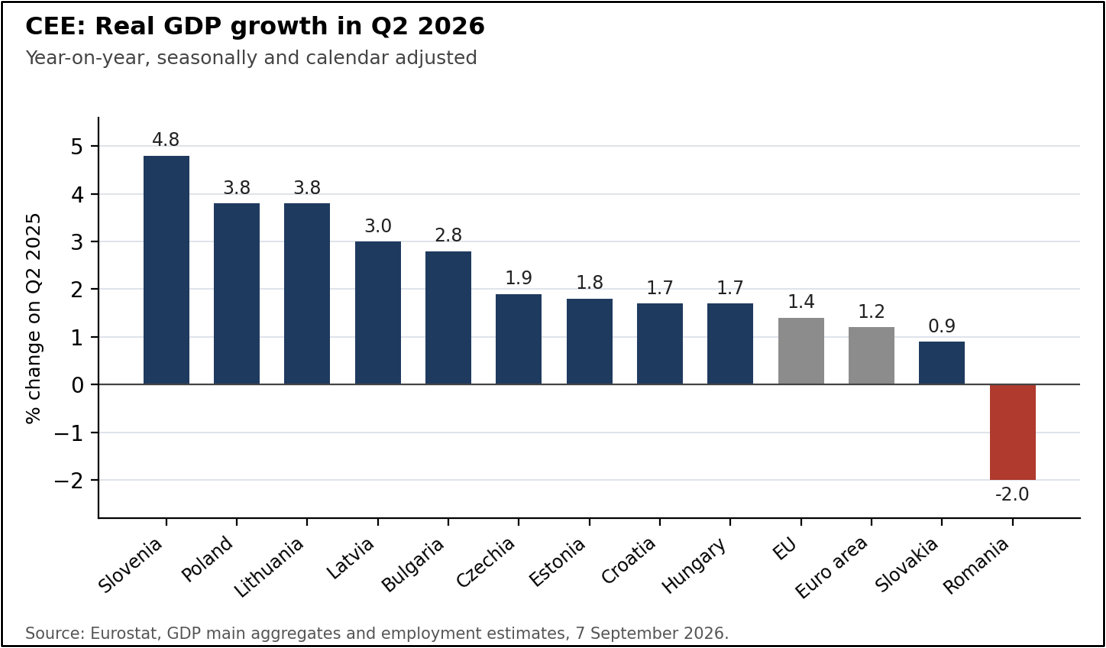
Eurostat’s latest estimate of second-quarter GDP, published on 7 September, shows how far growth rates now differ across the region. On a seasonally and calendar adjusted basis, Slovenia’s economy grew by 4.8% year-on-year, Poland and Lithuania by 3.8% and Latvia by 3.0%, compared with 1.4% for the EU as a whole. At the other end of the range, Slovakia grew by 0.9%, while Romania contracted by 2.0%. 

picture2-1789376830.png

CEE: second-quarter growth diverges. Real GDP, % change on Q2 2025, seasonally and calendar adjusted. Source: Eurostat. 

The euro-area aggregate was revised up to 0.6% quarter-on-quarter from 0.4% in the earlier flash estimate, with Ireland recording quarterly growth of 10.2%. For CEE, the more informative signal is the dispersion: almost seven percentage points separate Slovenia and Romania. As we noted last week, strong investment has been central to the recent performance of Poland and Slovenia. Romania shows what happens when consumption contracts at the same time. 

Romania: investment holds the economy up as consumption contracts

Romania’s National Institute of Statistics confirmed on 7 September that GDP was unchanged in the second quarter compared with the first, and 2.0% lower than a year earlier on a seasonally adjusted basis (0.4% lower on an unadjusted basis). In the first half of 2026, seasonally adjusted GDP was 1.6% below the same period of 2025. 

The composition is striking. According to the INS data, household final consumption fell by 2.5% in the first half, subtracting 1.5 percentage points from GDP growth, while gross fixed capital formation rose by 10.9%, contributing 2.4 percentage points. 

Romania is effectively running two economies at once: a household sector squeezed by fiscal consolidation and high inflation, with annual CPI inflation still at 8.16% in July, and an investment cycle that continues to expand. The durability of that investment cycle matters, particularly as RRF-financed projects must be paid out before the Facility closes at the end of 2026. August inflation data from INS and the National Bank of Romania’s next policy meeting on 8 October, with the policy rate at 6.50%, will indicate how quickly room for monetary easing might open up. 

Poland holds rates as fuel prices lift inflation towards the upper band

The NBP’s Monetary Policy Council kept interest rates unchanged at its meeting on 8–9 September, leaving the reference rate at 3.75%, where it has stood since March. According to Statistics Poland’s flash estimate, CPI inflation rose to 3.4% in August from 3.0% in July, just below the 3.5% upper limit of the tolerance band around the NBP’s 2.5% target. The increase was driven mainly by fuel prices, while food prices fell year-on-year. 

The Council’s statement noted robust GDP growth in the second quarter, with stronger investment and slower consumption, alongside the rise in inflation driven by higher fuel prices, and identified fiscal policy, economic activity and wage growth as risks to the inflation outlook. 

Poland illustrates the dilemma facing non-euro CEE central banks. Inflation is being pushed higher by an external supply shock that monetary policy cannot directly address, yet proximity to the upper band, combined with tighter policy at the ECB, has removed the scope for the easing that appeared possible earlier in the summer. Final August inflation data from Statistics Poland are due on 15 September. 

Czech central bank holds its capital buffer but signals a further increase has become more likely

The Czech National Bank’s Bank Board decided on 10 September to keep the countercyclical capital buffer rate at 1.5%. It said the Czech economy moved further into the expansionary phase of the financial cycle in the first half of 2026. Household credit activity remained high, partly because households increased their borrowing ahead of tighter conditions for investment mortgages and an expected rise in interest rates, while corporate lending for investment strengthened. 

The Board noted that household and corporate indebtedness remains moderate from a historical perspective, that banks are not easing credit standards across the board, and that the sector remains highly profitable and well capitalised. It added, however, that it stands ready to raise the buffer further if credit growth and indebtedness continue to rise, and that the likelihood of such a step has increased. 

Czech CPI inflation was 1.9% in August, up from 1.7% in July, with the monthly increase coming mainly from transport prices. The CNB raised its two-week repo rate to 3.75% in June. Czechia is therefore tightening both macroprudential and monetary settings while headline inflation remains below the 2% target, suggesting the CNB is weighing credit dynamics and the inflation outlook rather than the current headline rate alone. For banks, capital planning should allow for the possibility of a higher buffer requirement; for borrowers, the strength of recent mortgage demand is clearly being watched. 

Estonia’s inflation slows to 1.5% as food prices fall

Estonia’s consumer prices increased by 1.5% year-on-year in August, their smallest annual rise since spring 2021, according to Statistics Estonia. Prices were 0.4% higher than in July.

The components again show why the headline alone does not tell the whole story. Food and non-alcoholic beverages were 2.6% cheaper than a year earlier, while clothing and footwear declined by 4.6%. Housing costs, however, were 5.5% higher and transport prices increased by 7.2%. Goods overall rose by only 0.9%, compared with 2.4% for services.

For an economy operating directly under ECB monetary policy, the contrast is particularly striking. Domestic headline inflation is now relatively subdued just as euro-area interest rates are being increased in response to broader inflation pressures. Estonia therefore provides a clear example of the uneven national conditions through which a common monetary policy must operate.

This Week's Events to Watch

1
  • 14–15 September - Informal meeting of cohesion policy ministers: EU ministers responsible for cohesion policy meet in Dublin under the Irish Presidency. Cohesion funding remains one of the most important sources of public investment in CEE, and the discussion comes as the RRF approaches its end and negotiations on the 2028–2034 Multiannual Financial Framework continue.

  • 14 September - Croatia’s retail Treasury-bill subscription closes: The retail round for Croatia’s €1.75 billion 91-day Treasury bill closes at 11:00, which is also the deadline for reinvesting proceeds from the June issue. The new bills, carrying an annual yield of 2.75%, will be issued on 17 September. The level of household demand will be a useful follow-up to last week’s discussion of retail participation in government securities.

  • 15 September - Poland’s final August inflation data: Statistics Poland is due to publish full August CPI data, following the 3.4% flash estimate. The detailed breakdown, including core inflation, will show how far fuel prices are spreading into the wider basket.

  • 16 September - State of the Union: Commission President Ursula von der Leyen will deliver the 2026 State of the Union address during Parliament’s 14–17 September plenary session in Strasbourg. The speech will be closely watched for new initiatives on competitiveness, the Savings and Investments Union and the next EU budget.

  • 17 September - Czech National Bank monetary-policy decision: The CNB Bank Board holds its monetary-policy meeting, with the decision published at 14:30. The meeting comes a week after the ECB’s rate increase and follows the CNB’s signal that a further increase in the countercyclical capital buffer has become more likely.

  • 17 September - Eurostat full August inflation data: Eurostat will publish the complete set of August HICP data for the euro area, the EU and all Member States, including non-euro CEE economies, allowing a comparable view of how the energy shock is affecting inflation across the region.

  • 18–19 September - Eurogroup and informal ECOFIN: Euro-area finance ministers meet on 18 September, followed by an informal meeting of EU economy and finance ministers and central bank governors in Dublin on 18–19 September. The Irish Presidency has made the Savings and Investments Union, the digital euro and banking-sector integration among its financial-services priorities.

CEE Perspective Updates

1

A digital euro in the making: what will survive the negotiations?

CEE Perspective will turn to the digital euro on 29 September for the next CEE Perspective Academy webinar, as negotiations over the project’s legislative framework move through trilogue.

The discussion will bring together public-sector and industry perspectives to examine the choices still on the table, including holding limits, privacy and acceptance, distribution, costs and the interaction between a future digital euro and existing payment solutions.

For CEE, these questions are particularly relevant because the region combines euro-area and non-euro-area markets, highly developed domestic payment solutions in some countries and very different banking and payments structures across the region. The debate is therefore not only about the design of a new form of central-bank money, but also about how the eventual framework would work across different national financial ecosystems.

Register here: https://ceeperspective.eu/events/webinar-on-digital-euro

A digital euro in the making: what will survive the negotiations? Watch

Also On Our Radar

1
  • EBA: Commission declines to adopt faster prior-permission rules: The Commission has informed the EBA that it will not endorse the draft RTS submitted on 19 March 2026, which were intended to shorten the processing of applications for prior permission to reduce own funds and eligible liabilities instruments. Both the industry and competent authorities had considered the existing timelines unnecessarily lengthy. The EBA will instead proceed with a broader review of the RTS in line with the Commission’s proposal, aiming to deliver further simplification and efficiency gains at a later stage.

  • Supplementary pensions move from policy design to implementation questions: A Commission workshop on 10 September brought Member States together to examine practical approaches to auto-enrolment and supplementary pensions, including contribution structures, financial-sector capacity, fiscal incentives, lifecycle investment strategies and coverage of younger workers and the self-employed. The discussion is part of the Savings and Investments Union’s effort to expand long-term household investment and shows that the pension debate is increasingly moving from broad objectives towards the mechanics of national implementation.

  • Elsewhere in CEE: Hungary’s consumer prices were 1.3% higher in August than a year earlier, up from 1.2% in July, according to the Hungarian Central Statistical Office, with core inflation edging up to 2.0%. Inflation is therefore below the lower bound of the Magyar Nemzeti Bank’s tolerance band, in sharp contrast with Poland’s 3.4%. The Monetary Council will discuss its new Inflation Report at its meeting on 22 September.