
Newsletter • 7 September 2026

CEE Perspective Weekly Digest- Issue 13

CEE Perspective Weekly Digest- Issue 13

What's on the table this week

This week’s developments point to a question that is becoming increasingly important for Central and Eastern Europe: where will the region’s next phase of investment come from? 

The Recovery and Resilience Facility is entering its final phase at the same time as the EU is stepping up efforts to mobilise private capital through the Savings and Investments Union. The discussions on PEPP and occupational pensions are part of the same picture, reflecting a broader push to channel more of Europe’s household and institutional savings towards long-term investment. 

For CEE, this transition is particularly significant as investment needs remain substantial, while capital markets are generally less developed and bank lending and EU funding continue to play an important role. Yet this week also offers examples of how that landscape is evolving, from Croatia bringing households directly into government securities to Romania investing in domestic AI infrastructure through the EuroHPC framework. 

As exceptional EU funding gradually recedes, the challenge will increasingly be not only how much Europe saves, but how effectively those savings are connected to investment opportunities across the region.

Recent Key EU Developments

1

RRF enters its final implementation phase, raising the question of what comes next for investment

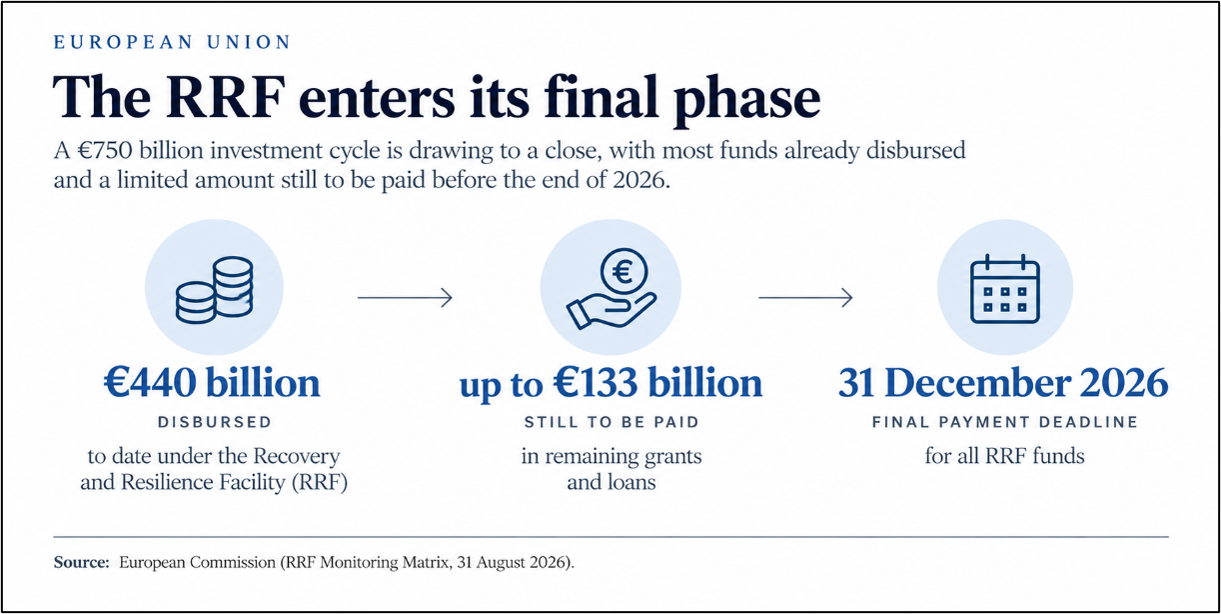
The EU’s Recovery and Resilience Facility (RRF) has reached a major milestone, with 31 August marking the deadline for Member States to complete the reforms and investments included in their national recovery and resilience plans. Around €440 billion had been disbursed by that point, while up to a further €133 billion remains to be paid before the Facility closes at the end of 2026. Member States have until 30 September to submit their final payment requests, with the Commission required to complete payments by 31 December. 
picture1-1788773368.png

The approaching end of the RRF shifts attention from implementation towards what follows. The Facility was designed as a temporary response to the pandemic, but it subsequently became an important source of financing for investment in energy, digitalisation, infrastructure and economic modernisation. Its expiry therefore comes as the EU is simultaneously debating the next Multiannual Financial Framework and how to mobilise significantly more private investment through the Savings and Investments Union. 

What this means for CEE markets: The transition is particularly relevant for Central and Eastern Europe, where EU funds have played an important role in supporting public investment and economic convergence. As the RRF winds down, the capacity of domestic financial systems to complement public funding will become increasingly important. Deeper capital markets, stronger institutional investment, bank financing and effective use of EIB and future EU instruments will all form part of the question of how the region sustains investment once the exceptional post-pandemic financing cycle ends. 

Pensions move further into the Savings and Investments Union debate

The European Parliament’s ECON Committee has held exchanges on both the Pan-European Personal Pension Product (PEPP) and the review of the IORP framework, offering an early indication of how Parliament is approaching the role of pensions within the Savings and Investments Union. 

On PEPP, there was broad support for reforms aimed at improving take-up while preserving national pension systems. EPP and Renew Europe stressed greater flexibility, portability and incentives for providers, while S&D placed greater emphasis on consumer protection, low costs, supervision and safeguards for existing public and occupational pension arrangements. Amendments are due by 21 September, with an ECON vote currently scheduled for 1 December. 

The IORP discussion similarly revealed broad support for maintaining the diversity of national occupational pension systems. Rapporteur Damian Boeselager identified transparency, simplification and greater portfolio diversification among his priorities. At the same time, MEPs stressed that members’ interests should remain central and warned against directing pension assets towards particular investment objectives, including mandatory allocations to venture capital. Renew Europe and S&D also emphasised the importance of maintaining a minimum-harmonisation approach and sufficient flexibility for national systems. 

What this means for CEE markets: The debate has particular significance for CEE because the depth and structure of funded pension systems vary substantially across the region. The broader EU objective of mobilising more long-term savings for productive investment therefore cannot translate into the same policy model everywhere. For countries with smaller institutional-investor bases and shallower capital markets, successful reform will depend not only on encouraging more pension saving but also on developing the domestic investment opportunities and market infrastructure capable of putting those savings to work. 

New EBA and ESMA leadership puts simplification and supervisory integration in focus

Recent ECON hearings for the incoming leadership of the European Banking Authority and European Securities and Markets Authority highlighted two closely connected themes shaping the EU financial-services agenda: reducing unnecessary regulatory complexity while pursuing greater integration of European financial markets.

During his hearing for EBA Executive Director, Thomas Gstaedtner argued for simplification without deregulation, including greater proportionality for small and non-complex institutions, simpler reporting requirements and less duplication between national and European reporting. 

Carlo Comporti, meanwhile, linked supervisory convergence to the effort to reduce fragmentation in European capital markets. While supporting a stronger role for ESMA where this can produce clear benefits, he also stressed subsidiarity and the importance of national supervisory expertise. He additionally identified technological change, including distributed-ledger technology and tokenisation, as an increasingly important part of ESMA’s agenda. 

What this means for CEE markets: Both debates matter for smaller CEE financial markets. Greater harmonisation and simpler EU rules can reduce the fixed costs of operating across relatively small national markets, while more integrated supervision could make cross-border activity easier. At the same time, the emphasis on proportionality and national expertise is particularly important for markets where institutions, market structures and supervisory capacity can differ substantially from those of the EU’s largest financial centres.
CEE Policy Radar

1

Romania begins implementation of its EuroHPC AI Factory

Romania has officially started implementation of the Romanian EuroHPC AI Factory, hosted by the National Institute for Research and Development in Informatics (ICI Bucharest). The project, which began on 1 September, is being developed under the EuroHPC framework, with ICI Bucharest acting as the hosting entity for the high-performance computing infrastructure and providing technical and operational support. 

The initiative brings together ICI Bucharest, the National University of Science and Technology POLITEHNICA Bucharest and other consortium partners. The objective is to expand access to advanced AI and high-performance computing capabilities and provide infrastructure that can be used by researchers, companies and other organisations developing AI applications. 

For Romania, the significance extends beyond the physical infrastructure. Access to large-scale computing capacity is becoming an important component of the AI ecosystem alongside data, skills and financing. The longer-term test will be whether publicly supported capacity can help build a broader commercial ecosystem connecting start-ups, universities, investors and industrial users. 

Poland’s economy expands by 3.9% in the second quarter

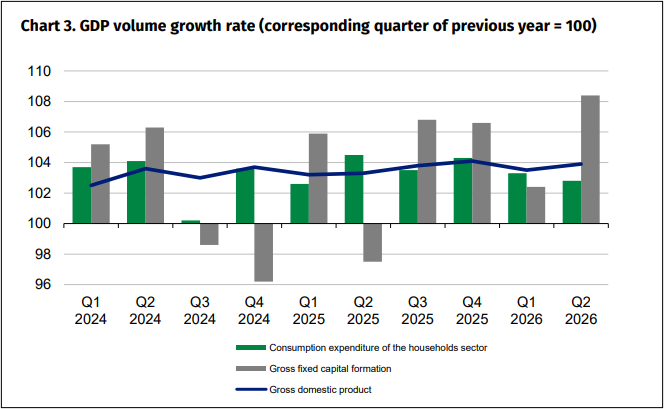
Poland’s economy continued to expand strongly in the second quarter of 2026. According to Statistics Poland, real GDP increased by 3.9% year-on-year, compared with 3.3% growth in the second quarter of 2025. On a seasonally adjusted basis, GDP grew by 1.0% compared with the previous quarter and by 3.8% compared with a year earlier. 

picture2-1788773430.png

Poland: investment strengthens as GDP growth reaches 3.9%. Gross fixed capital formation increased by 8.4% year-on-year in Q2 2026, while household consumption rose by 2.8%. Real GDP increased by 3.9%. Source: Statistics Poland. 

More significant than the headline growth rate is the composition of growth. Gross fixed capital formation increased by 8.4% year-on-year, with its contribution to GDP growth rising to 1.3 percentage points from 0.3 percentage points in the first quarter. The resilience of the Polish economy is particularly important for the wider CEE region given the size of its domestic market, its role in regional supply chains and its growing weight as a destination for investment. 

For financial markets, continued economic expansion provides a supportive backdrop for credit demand and corporate investment, although the composition and durability of growth will matter increasingly as the RRF investment cycle approaches its end. Poland will therefore provide an important test of whether strong domestic demand and private investment can sustain momentum as exceptional EU financing gradually recedes. 

Croatia turns again to households to finance government debt

Croatia will open subscriptions on 7 September for a new 91-day Treasury bill targeted initially at retail investors. The government is seeking a nominal €1.75 billion, with an annual yield of 2.75% and maturity on 17 December 2026. Citizens can subscribe digitally through the E-RIZNICA and M-RIZNICA platforms, while investors in the June Treasury-bill issue maturing on 17 September can reinvest their proceeds. 

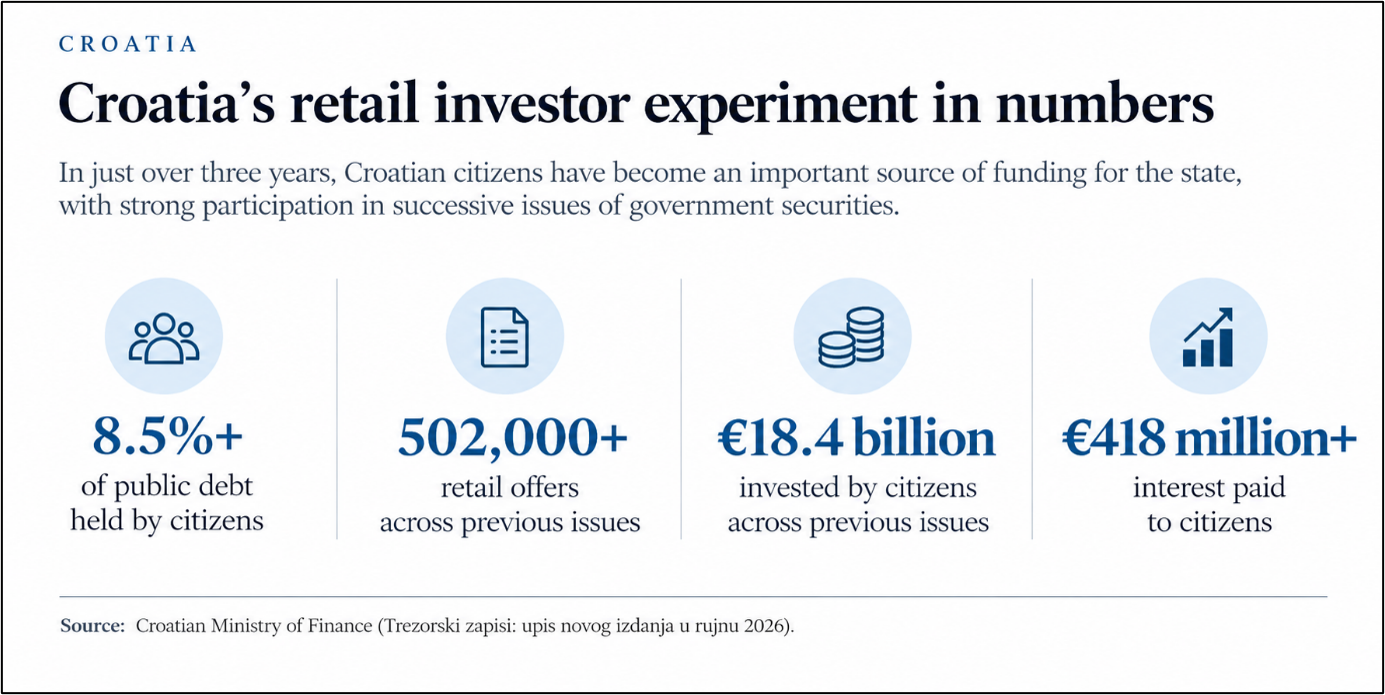
The latest issue is part of Croatia’s broader effort to expand direct household participation in government securities. According to the Ministry of Finance, citizens now hold more than 8.5% of Croatian public debt. Over slightly more than three years, households have submitted more than 502,000 offers worth a combined €18.4 billion across government securities issues open to retail investors and have received more than €418 million in interest.

picture3-1788773475.png

The Croatian experience is worth watching beyond sovereign financing. One of the central challenges facing the Savings and Investments Union is how to move a larger share of European household wealth beyond bank deposits and into financial assets. Retail government securities provide a relatively simple entry point into capital markets and can help build familiarity with investing. The longer-term question is whether this participation can eventually broaden into a wider range of savings and investment products.

This Week's Events to Watch

1
  • 7–8 September - Council discussions on securitisation: The Council Working Party on Financial Services and the Banking Union is scheduled to continue work on the EU securitisation framework. The file is closely connected to the SIU agenda and the broader objective of expanding banks’ capacity to transfer risk and finance the economy.

  • 9–10 September - ECB monetary-policy meeting: The ECB Governing Council meets in Berlin, hosted by the Deutsche Bundesbank, with its monetary-policy decisions and press conference scheduled for 10 September. The meeting will be closely watched following the latest inflation and financing data, particularly for signals on the outlook for monetary policy and borrowing conditions.

  • 10 September - European Parliament ECON Committee: SFDR review: ECON is expected to vote on the Parliament’s position on the SFDR review and on the mandate to enter interinstitutional negotiations. Approval would move the file towards trilogues and bring the EU closer to replacing the existing disclosure-centred regime with a more explicit product-categorisation framework.

  • 10 September - European Commission workshop on auto-enrolment and supplementary pensions: The Commission will hold a workshop for national administrations on saving for retirement through auto-enrolment and supplementary pensions. Discussions are expected to cover participation, default options, contribution structures, lifecycle investment strategies and extending pension coverage, including to groups such as younger workers and the self-employed.

  • 10 September - Council work on MISP and DLT: Financial Services Attachés are scheduled to continue negotiations on elements of the Market Integration and Supervision Package relating to trading and the DLT Pilot Regime. The discussions form part of the wider push to reduce fragmentation in EU capital markets and determine where greater European-level supervision may be justified.

Also On Our Radar

1
  • EIOPA proposes common minimum standards for insurance guarantee schemes: EIOPA has advised the Commission on minimum EU standards covering the scope, activation, claims, funding and operation of national Insurance Guarantee Schemes. The approach would retain national schemes while establishing a common minimum level of protection across the EU.

  • FSB highlights financial-sector risks from frontier AI: Financial Stability Board Chair Andrew Bailey has warned G20 Finance Ministers and Central Bank Governors that frontier AI could materially change the speed, scale and economics of cyber risk. The FSB is calling for jurisdictions to support safe and responsible deployment, with resilience and recovery capabilities becoming increasingly important as financial institutions and their service providers adopt more powerful AI systems.

  • New EU rules further specify banks’ operational-risk and reporting requirements: New Level 2 measures under the Capital Requirements Regulation establish a harmonised taxonomy and methodology for classifying operational-risk loss events and map business-indicator components to supervisory reporting references. The framework also includes a proportionality provision concerning when calculating annual operational-risk losses is considered unduly burdensome for institutions with a business indicator between €750 million and €1 billion.

  • Elsewhere in CEE: Slovenia recorded a sharp acceleration in the second quarter, with GDP increasing by 5.0% year-on-year. Fixed investment rose by 13.2% for the second consecutive quarter, partly reflecting government infrastructure projects and the completion of RRF-funded investment. The figures underline the question facing several CEE economies as the RRF cycle comes to an end: whether private investment can sustain momentum as EU-supported projects are completed.