Securitisation as a Strategic Instrument for Strengthening European Capital Markets
Opportunities, Risks, and Regulatory Perspectives
This article examines how securitisation is evolving from a post-crisis stigmatised instrument into a strategic pillar of the EU Capital Markets Union. Drawing on Mario Draghi's 2024 competitiveness report and recent regulatory developments—including Solvency II reforms, STS verification requirements, and green finance frameworks—it analyses the opportunities and structural barriers facing European securitisation markets, with particular attention to Central and Eastern Europe.
Authors

Topics
Article Content
"The European Union today faces an existential challenge and, if it does not change, it will be condemned to a slow agony."
— Mario Draghi, The Future of European Competitiveness, Report to the European Commission, presented on 9 September 2024.
In 2025, the European Union is entering a phase in which competitiveness is no longer discussed as an abstract objective, but as a test of institutional resilience. In this context, Mario Draghi's report on the future of EU competitiveness, prepared at the request of the European Commission and presented in 2024, delivers a diagnosis that has rarely been stated so directly: Europe will struggle to sustain growth, innovation, and strategic autonomy as long as capital remains "locked" in bank balance sheets and fragmented national financial ecosystems.
For more than a decade, the Union has relied primarily on bank lending as the main channel for financing the real economy—from SMEs and industrial value chains to infrastructure investment and the energy transition. This model, however, is reaching its limits not because banks are unwilling, but because the regulatory architecture structurally turns them into capital-intensive intermediaries: long-term risk is expensive, balance sheets are under pressure, and the capacity to take on new exposures at scale is finite. At the same time, Europe holds vast savings concentrated in insurance companies, pension funds, and asset managers—capital with a natural long-term horizon that nevertheless reaches productive investment only slowly and unevenly, especially outside the largest Western European markets.
It is precisely here that securitisation emerges not as a "financial trick" but as an infrastructural solution: a mechanism through which credit risk can be transferred in a transparent and standardised manner from the banking sector to the capital market. When portfolios of loans—to households, SMEs, infrastructure or climate-transition projects—are transformed into marketable instruments, they can be absorbed by investors with different risk appetites and investment mandates. In this way, bank balance sheets are "unburdened" and the released capital is recycled back into the economy in the form of new lending. In the United States, this logic underpins the depth and speed of capital allocation; in Europe, it remained systematically underdeveloped for a long time, not least because of the legacy of the 2008 crisis and the regulatory response that followed.
This is why the current political turn toward the rehabilitation of securitisation should be read as a strategic choice. In recent years, European institutions have increasingly acknowledged that without a functioning, large-scale and relatively unified securitisation market, the Capital Markets Union remains an incomplete project. And an "incomplete" CMU implies more expensive capital, weaker capacity to finance structural transitions, and lower competitiveness vis-à-vis jurisdictions where capital markets play a central role.
The Regulatory Architecture: From the Instinct of Restriction to the Logic of Functionality
If the post-2008 regulatory framework was primarily designed around restriction, containment, and the minimisation of systemic spillovers, 2024 legitimised the diagnosis that this approach had reached its functional limits, and 2025 confirmed the direction of treatment. The regulatory framework began to shift from "punitive" conservatism toward functionality, in which securitisation is expected to operate as an infrastructure for risk transfer rather than remaining formally permitted but economically discouraged. A key methodological clarification is required here: this shift is not deregulation, but an attempt at more risk-sensitive calibration—so that the price of risk becomes commensurate with the quality of the transaction and with the strategic need to finance economic transformation.
In this sense, the reforms surrounding Solvency II are illustrative. The debate over the capital treatment of securitised exposures held by insurers forms part of a broader revision of the regime, but what matters in the current phase is no longer only the direction of travel, but the fact that the recalibration has already entered into force. As of 1 January 2026, the amended Solvency II framework applies the revised capital charges for STS securitisations, including reduced capital factors for senior and non-senior STS tranches. These recalibrated capital factors apply exclusively to securitisations meeting the STS criteria; non-STS securitised exposures remain subject to significantly higher capital charges under the Solvency II standard formula.
At the same time, the significance of these reforms lies not only in their substantive content, but in the predictability of the regulatory trajectory. The amendments were introduced through a clearly signalled timeline and transitional logic, allowing market participants to anticipate their impact well in advance. As a result, the effect has been shaped both by market anticipation during 2025 and by the formal entry into force of the amended capital charges in early 2026. This predictability remains crucial for institutional investors, who respond not only to the law as it stands, but to whether the regulatory regime is becoming more stable, coherent and less punitive toward well-structured instruments.
It is important to clarify the legal perimeter of the EU Green Bond Regulation (EuGBR) in the context of securitisation. Under the current framework, securitisations cannot be formally certified as "EU Green Bonds", since the Regulation applies to bonds issued directly by undertakings and excludes asset-backed securities and synthetic tranches from the scope of the official label.
In practice, however, securitisations can voluntarily align with the EuGBR disclosure methodology and use-of-proceeds principles by ensuring that the underlying collateral pool is taxonomy-aligned and by applying EuGBR-style reporting and external review standards. As a result, market participants increasingly speak of "EuGBR-aligned" or "taxonomy-aligned" green securitisations rather than EuGBR-labelled instruments. This distinction is legally important: it preserves regulatory accuracy while still allowing securitisations to benefit from the credibility, comparability and investor recognition associated with the European green finance framework.
Since 1 January 2026, the STS regime has also incorporated a mandatory third-party verification layer. For public securitisations, any STS notification must now be accompanied by a verification report issued by an ESMA-registered STS verifier. Without this independent opinion, the STS notification has no legal effect. While this requirement strengthens market confidence and supervisory consistency, it also introduces additional transaction costs and capacity constraints, particularly for smaller issuers, making verifier availability a new operational bottleneck in parts of the market.
This shift has direct implications for insurers' investment behaviour. The entry into force of lower capital charges for STS securitisations improves the relative attractiveness of these instruments within insurers' asset allocations, particularly in an environment of heightened demand for yield-efficient, high-quality fixed-income assets. In this context, Solvency II functions not merely as a prudential constraint, but as a transmission mechanism through which regulatory calibration directly shapes market demand, supporting the gradual reintegration of securitisation into long-term institutional portfolios.
An additional and often underappreciated driver of renewed bank demand for securitisation since 2026 is its treatment under the Liquidity Coverage Ratio (LCR). As of 1 January 2026, STS securitisations—both ABCP and non-ABCP—that meet the relevant criteria and are rated at least investment grade are explicitly eligible as Level 2B High Quality Liquid Assets (HQLA) under the amended LCR Delegated Act. This change materially alters the treasury economics of holding securitised exposures: STS instruments are no longer penalised from a liquidity perspective, but can be held within regulatory liquidity buffers alongside other marketable securities. In practice, this has become a key factor supporting secondary-market demand by bank treasuries and reinforcing the overall regulatory attractiveness of high-quality European securitisations. As Level 2B assets, such instruments remain subject to the applicable regulatory haircuts and concentration caps under the LCR framework, which tempers but does not negate their improved liquidity treatment.
At the same time, the political framing of securitisation as part of the capital markets integration agenda has strengthened. In 2025, the European Commission placed the "revival" of securitisation at the core of the debate on mobilising private capital, including through the reassessment of certain burdens and the reduction of administrative frictions that make transactions more expensive and slower—especially for smaller issuers. The focus here is not abstract: market participants and analysts point out that the European regime is heavier and costlier than in competing jurisdictions, and this is increasingly perceived as a structural competitiveness problem.
Publicly cited market data indicate that European securitisation issuance has followed a cyclical but structurally stable trajectory over recent years. After reaching elevated levels around €230 billion in 2021, issuance declined during 2022 and 2023 amid tighter monetary conditions, heightened risk aversion, and regulatory uncertainty. This downward phase was followed by a rebound to approximately €210 billion in 2024, signalling a renewed increase in market activity and a gradual re-emergence of securitisation as a channel for financing and risk transfer under a more predictable regulatory environment. Importantly, this pattern suggests not a short-term fluctuation, but a broader adjustment process in which securitisation begins to regain functional relevance within European capital markets.
Table 1. Aggregate Dynamics of European Securitisation Issuance
| Year | Issuance (approx.) |
|---|---|
| 2020 | ~€180 billion |
| 2021 | ~€230 billion |
| 2022 | ~€200 billion |
| 2023 | ~€150 billion |
| 2024 | ~€210 billion |
Source: AFME Securitisation Data Snapshot 2024; ECB statistics; compiled and cited in Financial Times.
While the figures below are aggregate and indicative, they are sufficient to illustrate the underlying market dynamics relevant to the argument of this article. As institutional signals become clearer and expectations of a more functional regulatory regime strengthen, market activity tends to recover even before all legal reforms are fully applicable in their strictest formal sense.
Synthetic Risk Transfer (SRT) as the operational bridge between regulation and the real economy
At the operational level, the most significant development in the European securitisation framework over 2024–2025 has been the sustained expansion of the market for Synthetic Risk Transfer (SRT). Since the entry into force of Regulation (EU) 2021/557, synthetic securitisations may also qualify for the STS label provided they meet the specific STS criteria for synthetic transactions. As a result, SRT and STS are no longer mutually exclusive categories, and several STS-compliant synthetic transactions have been executed in recent years. While traditional structures require the legal and economic transfer of assets to special purpose vehicles, SRT allows only the credit risk to be transferred, with the exposures remaining on the bank's balance sheet. This feature is crucial for the economics of European lending: institutions preserve servicing, collateral structures and client relationships, while at the same time achieving regulatory-recognised capital relief.
It is important to stress that SRT is not a funding instrument and does not generate liquidity; its economic impact operates indirectly through regulatory capital relief and balance-sheet capacity.
This mechanism functions only insofar as supervisors accept that the risk has been genuinely and materially transferred. For that reason, the European SRT framework cannot be interpreted as a form of regulatory arbitrage. In practice, the assessment is governed by the quantitative tests set out in the EBA RTS on SRT, and regulatory capital relief becomes effective once these tests are met and the competent authority issues a non-objection letter within the prescribed timeframe. On the contrary, it represents an attempt to reconcile prudential stability with the economic need to use bank capital more efficiently. The European Banking Authority and national supervisors require demonstrable risk transfer, legal and economic irreversibility of the protection, and a clearly defined allocation of losses between banks and investors. Only under these conditions does SRT generate regulatory capital relief. For synthetic transactions seeking STS status, this regulatory recognition is conditional on strict risk-retention requirements. Originators must retain at least 5% of the net economic interest on a continuous basis throughout the life of the transaction. Failure to maintain this retention level results in the automatic loss of STS status and triggers materially higher capital and concentration charges. In practice, this requirement anchors the "skin in the game" principle within the synthetic securitisation framework and limits the scope for purely distributive risk transfer structures.
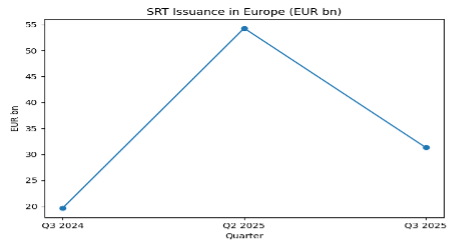
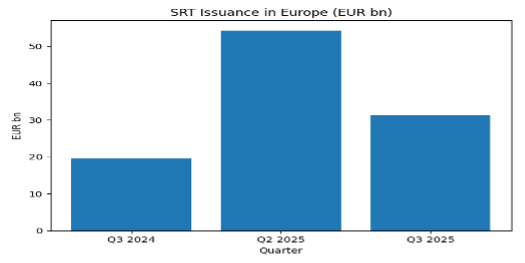
This logic is already visible in market data. Official statistics from the Association for Financial Markets in Europe (AFME) show that synthetic securitisations in Europe have become a systemic, rather than marginal, segment of the market during 2024–2025. In the third quarter of 2024, SRT issuance amounted to approximately €19.6 billion (AFME Securitisation Data Report Q3 2024). Just a few quarters later, in the second quarter of 2025, issuance reached €54.3 billion, representing year-on-year growth of more than 77% and more than a doubling compared with the previous quarter (AFME Q2 2025 Securitisation Report). In the third quarter of 2025, volumes normalised to around €31.3 billion of new SRT transactions, confirming that the instrument now operates as a stable flow, even though issuance remains inherently cyclical and sensitive to regulatory and market timing windows (AFME Q3 2025 Securitisation Report).
Figure 1 — SRT issuance in Europe by quarter (Q3 2024 – Q3 2025)
These figures should be interpreted in the context of the overall European securitisation market. In 2024, gross annual securitisation issuance in the EU reached approximately €245 billion, representing an increase of about 15% compared to 2023, while the total outstanding stock of securitised instruments exceeded €1.2 trillion (AFME Securitisation Data Snapshot Q4 2024 & Full Year 2024). This means that SRT is now embedded in a market of critical mass and is beginning to exert a real impact on the structure of European banks' balance sheets.
Figure 2: Total securitisation volume in the EU, 2023–2024
From an economic perspective, this process has a direct impact on lending capacity. International institutions, including the International Monetary Fund, emphasise that once significant risk transfer is recognised by supervisors, banks can reduce the capital burden attached to the relevant exposures and expand their capacity for new lending without raising additional equity. This is precisely why SRT is not viewed as an exotic derivative, but as an instrument of capital efficiency within a regulated banking system.
This logic is particularly relevant for Central and Eastern Europe. The region remains heavily dependent on bank financing, while capital markets are relatively shallow and fragmented. In this context, securitisation allows local subsidiaries to optimise their risk-weighted exposure profiles within group-wide capital constraints, which is critical for their ability to lend to the domestic economy without breaching intragroup concentration constraints. While SRT does not reduce nominal large-exposure limits, it improves capital efficiency at subsidiary level, thereby supporting sustained lending capacity within existing group structures. In such a structure, any mechanism that enables banks to transfer part of their risk to institutional investors and recycle capital has a disproportionately large effect on the real economy. Loans to SMEs, energy-efficiency projects or infrastructure can be transformed through SRT into marketable risk that is absorbed by insurers, pension funds and specialised credit funds, while banks free up balance-sheet and regulatory capacity for new investment.
In this sense, SRT is not merely a tool of bank balance-sheet management, but part of the broader architecture of the Capital Markets Union. When risk from CEE can be allocated to a pan-European and global investor base through standardised, supervisory-recognised structures, the region's financial dependence on local bank balance sheets is reduced. This is what turns synthetic securitisation into a key operational bridge between the EU's regulatory framework and the financing of the real economy.
Draghi's Vision versus Regulatory Reality (2024–2026)
To assess the real scale of the transformation underway in the European securitisation framework, the proposals formulated in Mario Draghi's report on the future competitiveness of the EU (September 2024) must be placed in direct dialogue with the regulatory measures developed and adopted during the 2024–2025 legislative cycle. Such a comparison makes it possible to trace how far regulatory reality is following the strategic vision, and which elements of that vision have already begun to produce measurable effects on bank capital and market dynamics.
Draghi's report starts from the premise that the European economy does not suffer from a lack of savings, but from an inefficient allocation of risk and capital. In this context, securitisation is identified as a systemic instrument capable of linking bank lending with capital markets and mobilising long-term private capital on a scale commensurate with the Union's strategic objectives. The regulatory proposals developed in 2024–2025 do not fully replicate the radicalism of this vision, but they clearly move in the same direction.
Table 2. Comparison between Draghi's Vision and Regulatory Reality (as of January 2026)
| Area of Reform | Draghi's Proposal (Sept. 2024) | Regulatory Status as of January 2026 | Expected Economic Impact |
|---|---|---|---|
| Supervisory architecture | Creation of a single European Securitisation Agency with centralised powers | Expanded coordination and supervisory functions for STS transactions and disclosure; strengthened harmonisation of supervisory practices, without the formal creation of a new agency | Reduction of regulatory arbitrage between Member States and more uniform application of transparency standards |
| Capital requirements | Significant easing of capital charges for banks and insurers for high-quality securitisations | Revision of parameters in banking and insurance regulation (including Solvency II), with a shift toward more risk-sensitive treatment and forward-looking implementation | Gradual release of regulatory capital and improved economic attractiveness of securitisation |
| Public and supranational guarantees | Use of public funds to support higher-risk tranches ("first-loss") | Pilot schemes and programmes of the European Investment Fund targeting SME and green portfolios, with co-investment features | Increased private-sector appetite for higher-risk but economically strategic assets |
| Standardisation and disclosure | Full harmonisation and simplification of documentation and procedures | Optimisation of ESMA disclosure templates and steps to reduce administrative burden | Lower legal and operational costs and faster transaction structuring |
STS = Simple, Transparent, Standardised
The comparison shows that, although some of Draghi's most radical proposals — such as the creation of a fully new supervisory authority — have not been implemented, regulatory evolution clearly follows the logic of his report. The approach is incremental rather than revolutionary, but it is precisely this feature that makes it politically sustainable within the European institutional architecture. The CMU 2.0 securitisation proposals remain subject to the ordinary legislative procedure and are not expected to enter into force before late 2026 at the earliest.
Despite this progress, European securitisation has not yet fully emerged from the shadow of its crisis legacy from 2008–2009. Analyses by major international financial institutions and investment banks, including J.P. Morgan and Deutsche Bank, consistently underline that the pace of development in the EU remains slower than in the United States. While in U.S. markets securitisation is primarily viewed as a tool for balance-sheet management and operational liquidity, in Europe it is still often perceived by parts of the political establishment through the lens of potential systemic instability.
This "delay" is also reflected in the structure of the regulatory package. Europe has made substantial progress in four key dimensions — supervisory coordination, capital requirements, public guarantees and standardisation — but the process remains gradual and cautious. At the same time, market data indicate that even this moderate reform has been sufficient to generate a measurable effect. According to figures published by industry associations and supervisory bodies, the total volume of the EU securitisation market reached approximately €210 billion in 2024, with a significant share of this growth linked to synthetic risk transfer. This demonstrates that the new model is already functioning and generating real capital capacity, even without the full implementation of all elements of Draghi's vision.
Finally, the integration of securitisation into the framework of the European Green Deal is contributing to a shift in public and investor perceptions. The introduction of European standards for green financial instruments, including their application to securitised products, addresses the key issue of trust through strict and comparable sustainability criteria. This has not only financial but also political implications, as it positions securitisation as an instrument for delivering strategic priorities rather than as a remnant of the pre-crisis financial model.
In this sense, it can be concluded that while in 2024 Draghi's vision appeared ambitious and at times theoretical, by early 2026 regulatory reality has turned it into a functioning framework. Although still incomplete, it is supported by market data and demonstrates the potential to transform the way in which the European Union finances its economic growth and strategic transitions.
Green securitisation: from an ESG label to verifiable market discipline
Green securitisation should be seen not as a "subcategory" of sustainable finance, but as a stress test for the maturity of the entire European ESG integration model. If sustainable finance is to function as a market infrastructure rather than as regulatory rhetoric, "green" cannot remain a matter of voluntary declarations and brand positioning. It must be provable, verifiable and comparable at the level of the individual asset. It is precisely at this point that the European sustainable finance framework — through the EU Taxonomy and the EU Green Bond Regulation (EuGBR) — fundamentally changes how securitisation is embedded in climate policy. While taxonomy alignment does not in itself entail preferential prudential treatment, it increasingly functions as a market-based pricing factor through investor mandates, eligibility criteria and disclosure-driven comparability.
Unlike early ESG practices, where "greenness" was often defined at portfolio or corporate level, the new regulatory architecture requires evidence at the level of each individual loan. For a securitisation to be marketed as green within the EU, the assets in its pool must be taxonomy-aligned — for example mortgages for highly energy-efficient buildings, renovation loans that lead to measurable improvements in energy performance, or loans for renewable energy projects. This requirement is not declarative: it is operationalised through mandatory loan-level data submitted to ESMA via the securitisation disclosure templates and subject to regulatory and investor scrutiny. In this way, "green" status ceases to be a matter of labelling and becomes a function of verifiable information and legal accountability (European Commission, Regulation (EU) 2020/852; Regulation (EU) 2023/2631; ESMA Securitisation Disclosure Framework).
This transformation turns green securitisation into an instrument of market discipline. Investors with ESG mandates no longer need to rely on aggregated portfolio assessments; they can analyse the actual characteristics of the assets they are taking exposure to. The risk of "greenwashing", which for a long time undermined trust in sustainable finance, is replaced by a regime of legally binding transparency and external verification under EuGBS. As a result, sustainability becomes a pricing factor rather than a reputational add-on.
This regulatory model is particularly significant for Central and Eastern Europe. The region holds one of the largest untapped "green" financial spaces in the EU: an ageing, energy-inefficient building stock and massive investment needs for renovation, heating systems and the integration of renewable energy. According to Eurostat and the European Investment Bank, more than two-thirds of buildings in CEE fall below energy class C, and renovations are financed predominantly through bank lending (EIB Investment Report, 2024). This creates exactly the type of asset base that is most suitable for green securitisations: large, homogeneous portfolios of loans with measurable environmental impact and a stable risk profile.
When these loans are structured into securitisation pools that comply with the Taxonomy and EuGBS, they cease to be a local banking product and become a European investment asset. Risk and return are distributed to pension funds, insurers and ESG funds across the EU, while local banks free up capital for new lending. In this way, climate policy is transformed into a mechanism of capital allocation — not through subsidies or administrative pressure, but through standardisation, transparency and the reduction of information asymmetry.
Table 3: Regulatory architecture of green securitisation in the EU
| Regulatory layer | Content | Legal basis |
|---|---|---|
| Asset classification | Assets in the securitisation pool must be aligned with the EU Taxonomy (e.g. energy-efficient buildings, renewable energy, renovations achieving ≥30% energy performance improvement) | Regulation (EU) 2020/852 |
| Use of proceeds | EuGBR use-of-proceeds and disclosure requirements may be applied on a voluntary basis to securitisations referencing taxonomy-aligned assets, although securitisations cannot be formally labelled as European Green Bonds | Regulation (EU) 2023/2631 (EuGBS) |
| Data and transparency | Mandatory loan-level ESG and climate indicators must be reported in securitisation disclosure templates | ESMA Securitisation Disclosure Framework |
| Reporting | Annual reports on allocation of proceeds and environmental impact | EuGBS |
| Verification | External independent verifiers, registered and supervised by ESMA | EuGBS Supervisory Regime |
Sources: European Commission (2020, 2023); ESMA (2024–2025)
In this institutional context, green ABS and green SRT are not "niche ESG products" but a new type of financial infrastructure. They allow the environmental characteristics of the real economy to be converted into investable risk with clear rules, high transparency and market liquidity. For Central and Eastern Europe, this means not simply access to more financing, but integration into the European flow of long-term capital — under conditions that reward energy efficiency, technological modernisation and sustainable growth.
The paradox of European sustainability: why a modern framework does not automatically deliver scale
Despite the strengthening of political support, European securitisation enters 2026 with a paradox: the rules are becoming clearer, but scale does not follow automatically. This is the point at which the constraints begin to look less legal and more structural — interest rate conditions, investment culture, technological integration and legal harmonisation.
The interest rate environment is the first obvious factor. After a period of extremely low rates, Europe is moving towards a higher price of money. This changes the economics of tranches, affects demand, and alters the price at which risk can be transferred to the market. Under higher rates and tighter competition for yield, issuers are squeezed between the need to offer an attractive spread and the desire to preserve the economic logic of the transaction. In Central and Eastern Europe, this pressure is amplified by currency and hedging costs in non-eurozone countries — a factor that can render an otherwise "correct" structure uneconomic if hedging absorbs the benefit.
The second zone is the techno-legal one. Digitalisation and ambitions for tokenisation or process automation are real, but legal harmonisation across the EU is uneven. When rights over digital representations of instruments or over certain forms of collateral are not equally "recognised" and enforceable across jurisdictions, the market starts to price not so much credit risk as legal uncertainty. This is a new form of fragmentation, which can become a "hidden cost" for smaller market participants.
Finally, there remains the cultural-political layer: securitisation in Europe still carries reputational baggage from the crisis narrative. Even when European structures have historically demonstrated better performance than some US practices, public memory and political caution often lead to a tendency towards national "over-insurance" through additional interpretations and procedures. This is the mechanism through which fragmentation reproduces itself even under formally harmonised rules — and it represents a material risk for the Capital Markets Union: not so much the risk of excessive risk-taking, but the risk of insufficient scale and insufficient speed of capital allocation.
By 2026, European securitisation is no longer a matter of legislative design, but of political economy. It is becoming a litmus test for the European Union's ability to turn its regulatory power into a geo-economic strategy. In a world where the United States and China use capital markets as tools of industrial policy, climate transition and technological leadership, Europe cannot afford to treat securitisation as a peripheral financial technique. Mario Draghi's report formulated this with unusual clarity: without large-scale reallocation of risk and capital from bank balance sheets to markets, the European economy will remain structurally under-financed — no matter how ambitious its goals may be.
The subsequent political shift showed that securitisation is now recognised as part of this transformation. The reforms in Solvency II, the LCR and the Significant Risk Transfer framework do not merely facilitate transactions; they create a new infrastructure for transferring credit risk to institutional capital. This is decisive, because it is precisely here that the EU's three major priorities intersect: the green transition, digitalisation and strategic autonomy. Without a mechanism that converts bank loans into marketable assets, none of these objectives can be financed at the necessary scale.
The real stake, however, is no longer regulatory, but cultural and institutional. Europe must decide whether it will accept securitisation as public infrastructure for economic development — analogous to energy networks or digital platforms — or continue to treat it as a "necessary but suspicious compromise" from the pre-2008 era. If the latter prevails, the Capital Markets Union will remain a project with elegant architecture but limited power. If the former takes hold, Europe — and especially Central and Eastern Europe — has all the prerequisites to turn securitisation into the primary mechanism for mobilising private capital for the next investment cycle, this time not as a source of instability, but as the backbone of sustainable growth.
About the author: Aneliya Petrova is an experienced professional with over 15 years of expertise in the capital markets, equity and fixed-income trading, securities sales, and the financial services industry. She holds a brokerage certificate from the Bulgarian Financial Supervision Commission, a Master's degree in Financial Management, and a Master's degree in Green Economy and Sustainable Development. Currently, she contributes to the CEE Perspective Association's research and policy initiatives, focusing on sustainable finance, financial literacy, and the integration of capital markets across Central and Eastern Europe. She is passionate about bridging the gap between knowledge, policy, and practice in building a more financially literate and sustainable Europe.
Article Content
"The European Union today faces an existential challenge and, if it does not change, it will be condemned to a slow agony."
— Mario Draghi, The Future of European Competitiveness, Report to the European Commission, presented on 9 September 2024.
In 2025, the European Union is entering a phase in which competitiveness is no longer discussed as an abstract objective, but as a test of institutional resilience. In this context, Mario Draghi's report on the future of EU competitiveness, prepared at the request of the European Commission and presented in 2024, delivers a diagnosis that has rarely been stated so directly: Europe will struggle to sustain growth, innovation, and strategic autonomy as long as capital remains "locked" in bank balance sheets and fragmented national financial ecosystems.
For more than a decade, the Union has relied primarily on bank lending as the main channel for financing the real economy—from SMEs and industrial value chains to infrastructure investment and the energy transition. This model, however, is reaching its limits not because banks are unwilling, but because the regulatory architecture structurally turns them into capital-intensive intermediaries: long-term risk is expensive, balance sheets are under pressure, and the capacity to take on new exposures at scale is finite. At the same time, Europe holds vast savings concentrated in insurance companies, pension funds, and asset managers—capital with a natural long-term horizon that nevertheless reaches productive investment only slowly and unevenly, especially outside the largest Western European markets.
It is precisely here that securitisation emerges not as a "financial trick" but as an infrastructural solution: a mechanism through which credit risk can be transferred in a transparent and standardised manner from the banking sector to the capital market. When portfolios of loans—to households, SMEs, infrastructure or climate-transition projects—are transformed into marketable instruments, they can be absorbed by investors with different risk appetites and investment mandates. In this way, bank balance sheets are "unburdened" and the released capital is recycled back into the economy in the form of new lending. In the United States, this logic underpins the depth and speed of capital allocation; in Europe, it remained systematically underdeveloped for a long time, not least because of the legacy of the 2008 crisis and the regulatory response that followed.
This is why the current political turn toward the rehabilitation of securitisation should be read as a strategic choice. In recent years, European institutions have increasingly acknowledged that without a functioning, large-scale and relatively unified securitisation market, the Capital Markets Union remains an incomplete project. And an "incomplete" CMU implies more expensive capital, weaker capacity to finance structural transitions, and lower competitiveness vis-à-vis jurisdictions where capital markets play a central role.
The Regulatory Architecture: From the Instinct of Restriction to the Logic of Functionality
If the post-2008 regulatory framework was primarily designed around restriction, containment, and the minimisation of systemic spillovers, 2024 legitimised the diagnosis that this approach had reached its functional limits, and 2025 confirmed the direction of treatment. The regulatory framework began to shift from "punitive" conservatism toward functionality, in which securitisation is expected to operate as an infrastructure for risk transfer rather than remaining formally permitted but economically discouraged. A key methodological clarification is required here: this shift is not deregulation, but an attempt at more risk-sensitive calibration—so that the price of risk becomes commensurate with the quality of the transaction and with the strategic need to finance economic transformation.
In this sense, the reforms surrounding Solvency II are illustrative. The debate over the capital treatment of securitised exposures held by insurers forms part of a broader revision of the regime, but what matters in the current phase is no longer only the direction of travel, but the fact that the recalibration has already entered into force. As of 1 January 2026, the amended Solvency II framework applies the revised capital charges for STS securitisations, including reduced capital factors for senior and non-senior STS tranches. These recalibrated capital factors apply exclusively to securitisations meeting the STS criteria; non-STS securitised exposures remain subject to significantly higher capital charges under the Solvency II standard formula.
At the same time, the significance of these reforms lies not only in their substantive content, but in the predictability of the regulatory trajectory. The amendments were introduced through a clearly signalled timeline and transitional logic, allowing market participants to anticipate their impact well in advance. As a result, the effect has been shaped both by market anticipation during 2025 and by the formal entry into force of the amended capital charges in early 2026. This predictability remains crucial for institutional investors, who respond not only to the law as it stands, but to whether the regulatory regime is becoming more stable, coherent and less punitive toward well-structured instruments.
It is important to clarify the legal perimeter of the EU Green Bond Regulation (EuGBR) in the context of securitisation. Under the current framework, securitisations cannot be formally certified as "EU Green Bonds", since the Regulation applies to bonds issued directly by undertakings and excludes asset-backed securities and synthetic tranches from the scope of the official label.
In practice, however, securitisations can voluntarily align with the EuGBR disclosure methodology and use-of-proceeds principles by ensuring that the underlying collateral pool is taxonomy-aligned and by applying EuGBR-style reporting and external review standards. As a result, market participants increasingly speak of "EuGBR-aligned" or "taxonomy-aligned" green securitisations rather than EuGBR-labelled instruments. This distinction is legally important: it preserves regulatory accuracy while still allowing securitisations to benefit from the credibility, comparability and investor recognition associated with the European green finance framework.
Since 1 January 2026, the STS regime has also incorporated a mandatory third-party verification layer. For public securitisations, any STS notification must now be accompanied by a verification report issued by an ESMA-registered STS verifier. Without this independent opinion, the STS notification has no legal effect. While this requirement strengthens market confidence and supervisory consistency, it also introduces additional transaction costs and capacity constraints, particularly for smaller issuers, making verifier availability a new operational bottleneck in parts of the market.
This shift has direct implications for insurers' investment behaviour. The entry into force of lower capital charges for STS securitisations improves the relative attractiveness of these instruments within insurers' asset allocations, particularly in an environment of heightened demand for yield-efficient, high-quality fixed-income assets. In this context, Solvency II functions not merely as a prudential constraint, but as a transmission mechanism through which regulatory calibration directly shapes market demand, supporting the gradual reintegration of securitisation into long-term institutional portfolios.
An additional and often underappreciated driver of renewed bank demand for securitisation since 2026 is its treatment under the Liquidity Coverage Ratio (LCR). As of 1 January 2026, STS securitisations—both ABCP and non-ABCP—that meet the relevant criteria and are rated at least investment grade are explicitly eligible as Level 2B High Quality Liquid Assets (HQLA) under the amended LCR Delegated Act. This change materially alters the treasury economics of holding securitised exposures: STS instruments are no longer penalised from a liquidity perspective, but can be held within regulatory liquidity buffers alongside other marketable securities. In practice, this has become a key factor supporting secondary-market demand by bank treasuries and reinforcing the overall regulatory attractiveness of high-quality European securitisations. As Level 2B assets, such instruments remain subject to the applicable regulatory haircuts and concentration caps under the LCR framework, which tempers but does not negate their improved liquidity treatment.
At the same time, the political framing of securitisation as part of the capital markets integration agenda has strengthened. In 2025, the European Commission placed the "revival" of securitisation at the core of the debate on mobilising private capital, including through the reassessment of certain burdens and the reduction of administrative frictions that make transactions more expensive and slower—especially for smaller issuers. The focus here is not abstract: market participants and analysts point out that the European regime is heavier and costlier than in competing jurisdictions, and this is increasingly perceived as a structural competitiveness problem.
Publicly cited market data indicate that European securitisation issuance has followed a cyclical but structurally stable trajectory over recent years. After reaching elevated levels around €230 billion in 2021, issuance declined during 2022 and 2023 amid tighter monetary conditions, heightened risk aversion, and regulatory uncertainty. This downward phase was followed by a rebound to approximately €210 billion in 2024, signalling a renewed increase in market activity and a gradual re-emergence of securitisation as a channel for financing and risk transfer under a more predictable regulatory environment. Importantly, this pattern suggests not a short-term fluctuation, but a broader adjustment process in which securitisation begins to regain functional relevance within European capital markets.
Table 1. Aggregate Dynamics of European Securitisation Issuance
| Year | Issuance (approx.) |
|---|---|
| 2020 | ~€180 billion |
| 2021 | ~€230 billion |
| 2022 | ~€200 billion |
| 2023 | ~€150 billion |
| 2024 | ~€210 billion |
Source: AFME Securitisation Data Snapshot 2024; ECB statistics; compiled and cited in Financial Times.
While the figures below are aggregate and indicative, they are sufficient to illustrate the underlying market dynamics relevant to the argument of this article. As institutional signals become clearer and expectations of a more functional regulatory regime strengthen, market activity tends to recover even before all legal reforms are fully applicable in their strictest formal sense.
Synthetic Risk Transfer (SRT) as the operational bridge between regulation and the real economy
At the operational level, the most significant development in the European securitisation framework over 2024–2025 has been the sustained expansion of the market for Synthetic Risk Transfer (SRT). Since the entry into force of Regulation (EU) 2021/557, synthetic securitisations may also qualify for the STS label provided they meet the specific STS criteria for synthetic transactions. As a result, SRT and STS are no longer mutually exclusive categories, and several STS-compliant synthetic transactions have been executed in recent years. While traditional structures require the legal and economic transfer of assets to special purpose vehicles, SRT allows only the credit risk to be transferred, with the exposures remaining on the bank's balance sheet. This feature is crucial for the economics of European lending: institutions preserve servicing, collateral structures and client relationships, while at the same time achieving regulatory-recognised capital relief.
It is important to stress that SRT is not a funding instrument and does not generate liquidity; its economic impact operates indirectly through regulatory capital relief and balance-sheet capacity.
This mechanism functions only insofar as supervisors accept that the risk has been genuinely and materially transferred. For that reason, the European SRT framework cannot be interpreted as a form of regulatory arbitrage. In practice, the assessment is governed by the quantitative tests set out in the EBA RTS on SRT, and regulatory capital relief becomes effective once these tests are met and the competent authority issues a non-objection letter within the prescribed timeframe. On the contrary, it represents an attempt to reconcile prudential stability with the economic need to use bank capital more efficiently. The European Banking Authority and national supervisors require demonstrable risk transfer, legal and economic irreversibility of the protection, and a clearly defined allocation of losses between banks and investors. Only under these conditions does SRT generate regulatory capital relief. For synthetic transactions seeking STS status, this regulatory recognition is conditional on strict risk-retention requirements. Originators must retain at least 5% of the net economic interest on a continuous basis throughout the life of the transaction. Failure to maintain this retention level results in the automatic loss of STS status and triggers materially higher capital and concentration charges. In practice, this requirement anchors the "skin in the game" principle within the synthetic securitisation framework and limits the scope for purely distributive risk transfer structures.
This logic is already visible in market data. Official statistics from the Association for Financial Markets in Europe (AFME) show that synthetic securitisations in Europe have become a systemic, rather than marginal, segment of the market during 2024–2025. In the third quarter of 2024, SRT issuance amounted to approximately €19.6 billion (AFME Securitisation Data Report Q3 2024). Just a few quarters later, in the second quarter of 2025, issuance reached €54.3 billion, representing year-on-year growth of more than 77% and more than a doubling compared with the previous quarter (AFME Q2 2025 Securitisation Report). In the third quarter of 2025, volumes normalised to around €31.3 billion of new SRT transactions, confirming that the instrument now operates as a stable flow, even though issuance remains inherently cyclical and sensitive to regulatory and market timing windows (AFME Q3 2025 Securitisation Report).
Figure 1 — SRT issuance in Europe by quarter (Q3 2024 – Q3 2025)
These figures should be interpreted in the context of the overall European securitisation market. In 2024, gross annual securitisation issuance in the EU reached approximately €245 billion, representing an increase of about 15% compared to 2023, while the total outstanding stock of securitised instruments exceeded €1.2 trillion (AFME Securitisation Data Snapshot Q4 2024 & Full Year 2024). This means that SRT is now embedded in a market of critical mass and is beginning to exert a real impact on the structure of European banks' balance sheets.
Figure 2: Total securitisation volume in the EU, 2023–2024
From an economic perspective, this process has a direct impact on lending capacity. International institutions, including the International Monetary Fund, emphasise that once significant risk transfer is recognised by supervisors, banks can reduce the capital burden attached to the relevant exposures and expand their capacity for new lending without raising additional equity. This is precisely why SRT is not viewed as an exotic derivative, but as an instrument of capital efficiency within a regulated banking system.
This logic is particularly relevant for Central and Eastern Europe. The region remains heavily dependent on bank financing, while capital markets are relatively shallow and fragmented. In this context, securitisation allows local subsidiaries to optimise their risk-weighted exposure profiles within group-wide capital constraints, which is critical for their ability to lend to the domestic economy without breaching intragroup concentration constraints. While SRT does not reduce nominal large-exposure limits, it improves capital efficiency at subsidiary level, thereby supporting sustained lending capacity within existing group structures. In such a structure, any mechanism that enables banks to transfer part of their risk to institutional investors and recycle capital has a disproportionately large effect on the real economy. Loans to SMEs, energy-efficiency projects or infrastructure can be transformed through SRT into marketable risk that is absorbed by insurers, pension funds and specialised credit funds, while banks free up balance-sheet and regulatory capacity for new investment.
In this sense, SRT is not merely a tool of bank balance-sheet management, but part of the broader architecture of the Capital Markets Union. When risk from CEE can be allocated to a pan-European and global investor base through standardised, supervisory-recognised structures, the region's financial dependence on local bank balance sheets is reduced. This is what turns synthetic securitisation into a key operational bridge between the EU's regulatory framework and the financing of the real economy.
Draghi's Vision versus Regulatory Reality (2024–2026)
To assess the real scale of the transformation underway in the European securitisation framework, the proposals formulated in Mario Draghi's report on the future competitiveness of the EU (September 2024) must be placed in direct dialogue with the regulatory measures developed and adopted during the 2024–2025 legislative cycle. Such a comparison makes it possible to trace how far regulatory reality is following the strategic vision, and which elements of that vision have already begun to produce measurable effects on bank capital and market dynamics.
Draghi's report starts from the premise that the European economy does not suffer from a lack of savings, but from an inefficient allocation of risk and capital. In this context, securitisation is identified as a systemic instrument capable of linking bank lending with capital markets and mobilising long-term private capital on a scale commensurate with the Union's strategic objectives. The regulatory proposals developed in 2024–2025 do not fully replicate the radicalism of this vision, but they clearly move in the same direction.
Table 2. Comparison between Draghi's Vision and Regulatory Reality (as of January 2026)
| Area of Reform | Draghi's Proposal (Sept. 2024) | Regulatory Status as of January 2026 | Expected Economic Impact |
|---|---|---|---|
| Supervisory architecture | Creation of a single European Securitisation Agency with centralised powers | Expanded coordination and supervisory functions for STS transactions and disclosure; strengthened harmonisation of supervisory practices, without the formal creation of a new agency | Reduction of regulatory arbitrage between Member States and more uniform application of transparency standards |
| Capital requirements | Significant easing of capital charges for banks and insurers for high-quality securitisations | Revision of parameters in banking and insurance regulation (including Solvency II), with a shift toward more risk-sensitive treatment and forward-looking implementation | Gradual release of regulatory capital and improved economic attractiveness of securitisation |
| Public and supranational guarantees | Use of public funds to support higher-risk tranches ("first-loss") | Pilot schemes and programmes of the European Investment Fund targeting SME and green portfolios, with co-investment features | Increased private-sector appetite for higher-risk but economically strategic assets |
| Standardisation and disclosure | Full harmonisation and simplification of documentation and procedures | Optimisation of ESMA disclosure templates and steps to reduce administrative burden | Lower legal and operational costs and faster transaction structuring |
STS = Simple, Transparent, Standardised
The comparison shows that, although some of Draghi's most radical proposals — such as the creation of a fully new supervisory authority — have not been implemented, regulatory evolution clearly follows the logic of his report. The approach is incremental rather than revolutionary, but it is precisely this feature that makes it politically sustainable within the European institutional architecture. The CMU 2.0 securitisation proposals remain subject to the ordinary legislative procedure and are not expected to enter into force before late 2026 at the earliest.
Despite this progress, European securitisation has not yet fully emerged from the shadow of its crisis legacy from 2008–2009. Analyses by major international financial institutions and investment banks, including J.P. Morgan and Deutsche Bank, consistently underline that the pace of development in the EU remains slower than in the United States. While in U.S. markets securitisation is primarily viewed as a tool for balance-sheet management and operational liquidity, in Europe it is still often perceived by parts of the political establishment through the lens of potential systemic instability.
This "delay" is also reflected in the structure of the regulatory package. Europe has made substantial progress in four key dimensions — supervisory coordination, capital requirements, public guarantees and standardisation — but the process remains gradual and cautious. At the same time, market data indicate that even this moderate reform has been sufficient to generate a measurable effect. According to figures published by industry associations and supervisory bodies, the total volume of the EU securitisation market reached approximately €210 billion in 2024, with a significant share of this growth linked to synthetic risk transfer. This demonstrates that the new model is already functioning and generating real capital capacity, even without the full implementation of all elements of Draghi's vision.
Finally, the integration of securitisation into the framework of the European Green Deal is contributing to a shift in public and investor perceptions. The introduction of European standards for green financial instruments, including their application to securitised products, addresses the key issue of trust through strict and comparable sustainability criteria. This has not only financial but also political implications, as it positions securitisation as an instrument for delivering strategic priorities rather than as a remnant of the pre-crisis financial model.
In this sense, it can be concluded that while in 2024 Draghi's vision appeared ambitious and at times theoretical, by early 2026 regulatory reality has turned it into a functioning framework. Although still incomplete, it is supported by market data and demonstrates the potential to transform the way in which the European Union finances its economic growth and strategic transitions.
Green securitisation: from an ESG label to verifiable market discipline
Green securitisation should be seen not as a "subcategory" of sustainable finance, but as a stress test for the maturity of the entire European ESG integration model. If sustainable finance is to function as a market infrastructure rather than as regulatory rhetoric, "green" cannot remain a matter of voluntary declarations and brand positioning. It must be provable, verifiable and comparable at the level of the individual asset. It is precisely at this point that the European sustainable finance framework — through the EU Taxonomy and the EU Green Bond Regulation (EuGBR) — fundamentally changes how securitisation is embedded in climate policy. While taxonomy alignment does not in itself entail preferential prudential treatment, it increasingly functions as a market-based pricing factor through investor mandates, eligibility criteria and disclosure-driven comparability.
Unlike early ESG practices, where "greenness" was often defined at portfolio or corporate level, the new regulatory architecture requires evidence at the level of each individual loan. For a securitisation to be marketed as green within the EU, the assets in its pool must be taxonomy-aligned — for example mortgages for highly energy-efficient buildings, renovation loans that lead to measurable improvements in energy performance, or loans for renewable energy projects. This requirement is not declarative: it is operationalised through mandatory loan-level data submitted to ESMA via the securitisation disclosure templates and subject to regulatory and investor scrutiny. In this way, "green" status ceases to be a matter of labelling and becomes a function of verifiable information and legal accountability (European Commission, Regulation (EU) 2020/852; Regulation (EU) 2023/2631; ESMA Securitisation Disclosure Framework).
This transformation turns green securitisation into an instrument of market discipline. Investors with ESG mandates no longer need to rely on aggregated portfolio assessments; they can analyse the actual characteristics of the assets they are taking exposure to. The risk of "greenwashing", which for a long time undermined trust in sustainable finance, is replaced by a regime of legally binding transparency and external verification under EuGBS. As a result, sustainability becomes a pricing factor rather than a reputational add-on.
This regulatory model is particularly significant for Central and Eastern Europe. The region holds one of the largest untapped "green" financial spaces in the EU: an ageing, energy-inefficient building stock and massive investment needs for renovation, heating systems and the integration of renewable energy. According to Eurostat and the European Investment Bank, more than two-thirds of buildings in CEE fall below energy class C, and renovations are financed predominantly through bank lending (EIB Investment Report, 2024). This creates exactly the type of asset base that is most suitable for green securitisations: large, homogeneous portfolios of loans with measurable environmental impact and a stable risk profile.
When these loans are structured into securitisation pools that comply with the Taxonomy and EuGBS, they cease to be a local banking product and become a European investment asset. Risk and return are distributed to pension funds, insurers and ESG funds across the EU, while local banks free up capital for new lending. In this way, climate policy is transformed into a mechanism of capital allocation — not through subsidies or administrative pressure, but through standardisation, transparency and the reduction of information asymmetry.
Table 3: Regulatory architecture of green securitisation in the EU
| Regulatory layer | Content | Legal basis |
|---|---|---|
| Asset classification | Assets in the securitisation pool must be aligned with the EU Taxonomy (e.g. energy-efficient buildings, renewable energy, renovations achieving ≥30% energy performance improvement) | Regulation (EU) 2020/852 |
| Use of proceeds | EuGBR use-of-proceeds and disclosure requirements may be applied on a voluntary basis to securitisations referencing taxonomy-aligned assets, although securitisations cannot be formally labelled as European Green Bonds | Regulation (EU) 2023/2631 (EuGBS) |
| Data and transparency | Mandatory loan-level ESG and climate indicators must be reported in securitisation disclosure templates | ESMA Securitisation Disclosure Framework |
| Reporting | Annual reports on allocation of proceeds and environmental impact | EuGBS |
| Verification | External independent verifiers, registered and supervised by ESMA | EuGBS Supervisory Regime |
Sources: European Commission (2020, 2023); ESMA (2024–2025)
In this institutional context, green ABS and green SRT are not "niche ESG products" but a new type of financial infrastructure. They allow the environmental characteristics of the real economy to be converted into investable risk with clear rules, high transparency and market liquidity. For Central and Eastern Europe, this means not simply access to more financing, but integration into the European flow of long-term capital — under conditions that reward energy efficiency, technological modernisation and sustainable growth.
The paradox of European sustainability: why a modern framework does not automatically deliver scale
Despite the strengthening of political support, European securitisation enters 2026 with a paradox: the rules are becoming clearer, but scale does not follow automatically. This is the point at which the constraints begin to look less legal and more structural — interest rate conditions, investment culture, technological integration and legal harmonisation.
The interest rate environment is the first obvious factor. After a period of extremely low rates, Europe is moving towards a higher price of money. This changes the economics of tranches, affects demand, and alters the price at which risk can be transferred to the market. Under higher rates and tighter competition for yield, issuers are squeezed between the need to offer an attractive spread and the desire to preserve the economic logic of the transaction. In Central and Eastern Europe, this pressure is amplified by currency and hedging costs in non-eurozone countries — a factor that can render an otherwise "correct" structure uneconomic if hedging absorbs the benefit.
The second zone is the techno-legal one. Digitalisation and ambitions for tokenisation or process automation are real, but legal harmonisation across the EU is uneven. When rights over digital representations of instruments or over certain forms of collateral are not equally "recognised" and enforceable across jurisdictions, the market starts to price not so much credit risk as legal uncertainty. This is a new form of fragmentation, which can become a "hidden cost" for smaller market participants.
Finally, there remains the cultural-political layer: securitisation in Europe still carries reputational baggage from the crisis narrative. Even when European structures have historically demonstrated better performance than some US practices, public memory and political caution often lead to a tendency towards national "over-insurance" through additional interpretations and procedures. This is the mechanism through which fragmentation reproduces itself even under formally harmonised rules — and it represents a material risk for the Capital Markets Union: not so much the risk of excessive risk-taking, but the risk of insufficient scale and insufficient speed of capital allocation.
By 2026, European securitisation is no longer a matter of legislative design, but of political economy. It is becoming a litmus test for the European Union's ability to turn its regulatory power into a geo-economic strategy. In a world where the United States and China use capital markets as tools of industrial policy, climate transition and technological leadership, Europe cannot afford to treat securitisation as a peripheral financial technique. Mario Draghi's report formulated this with unusual clarity: without large-scale reallocation of risk and capital from bank balance sheets to markets, the European economy will remain structurally under-financed — no matter how ambitious its goals may be.
The subsequent political shift showed that securitisation is now recognised as part of this transformation. The reforms in Solvency II, the LCR and the Significant Risk Transfer framework do not merely facilitate transactions; they create a new infrastructure for transferring credit risk to institutional capital. This is decisive, because it is precisely here that the EU's three major priorities intersect: the green transition, digitalisation and strategic autonomy. Without a mechanism that converts bank loans into marketable assets, none of these objectives can be financed at the necessary scale.
The real stake, however, is no longer regulatory, but cultural and institutional. Europe must decide whether it will accept securitisation as public infrastructure for economic development — analogous to energy networks or digital platforms — or continue to treat it as a "necessary but suspicious compromise" from the pre-2008 era. If the latter prevails, the Capital Markets Union will remain a project with elegant architecture but limited power. If the former takes hold, Europe — and especially Central and Eastern Europe — has all the prerequisites to turn securitisation into the primary mechanism for mobilising private capital for the next investment cycle, this time not as a source of instability, but as the backbone of sustainable growth.
About the author: Aneliya Petrova is an experienced professional with over 15 years of expertise in the capital markets, equity and fixed-income trading, securities sales, and the financial services industry. She holds a brokerage certificate from the Bulgarian Financial Supervision Commission, a Master's degree in Financial Management, and a Master's degree in Green Economy and Sustainable Development. Currently, she contributes to the CEE Perspective Association's research and policy initiatives, focusing on sustainable finance, financial literacy, and the integration of capital markets across Central and Eastern Europe. She is passionate about bridging the gap between knowledge, policy, and practice in building a more financially literate and sustainable Europe.