Europe’s Hidden Trillion: Why Pension Capital Fails to Finance Growth
Europe’s Pension Wealth Is Vast - But Structurally Misallocated
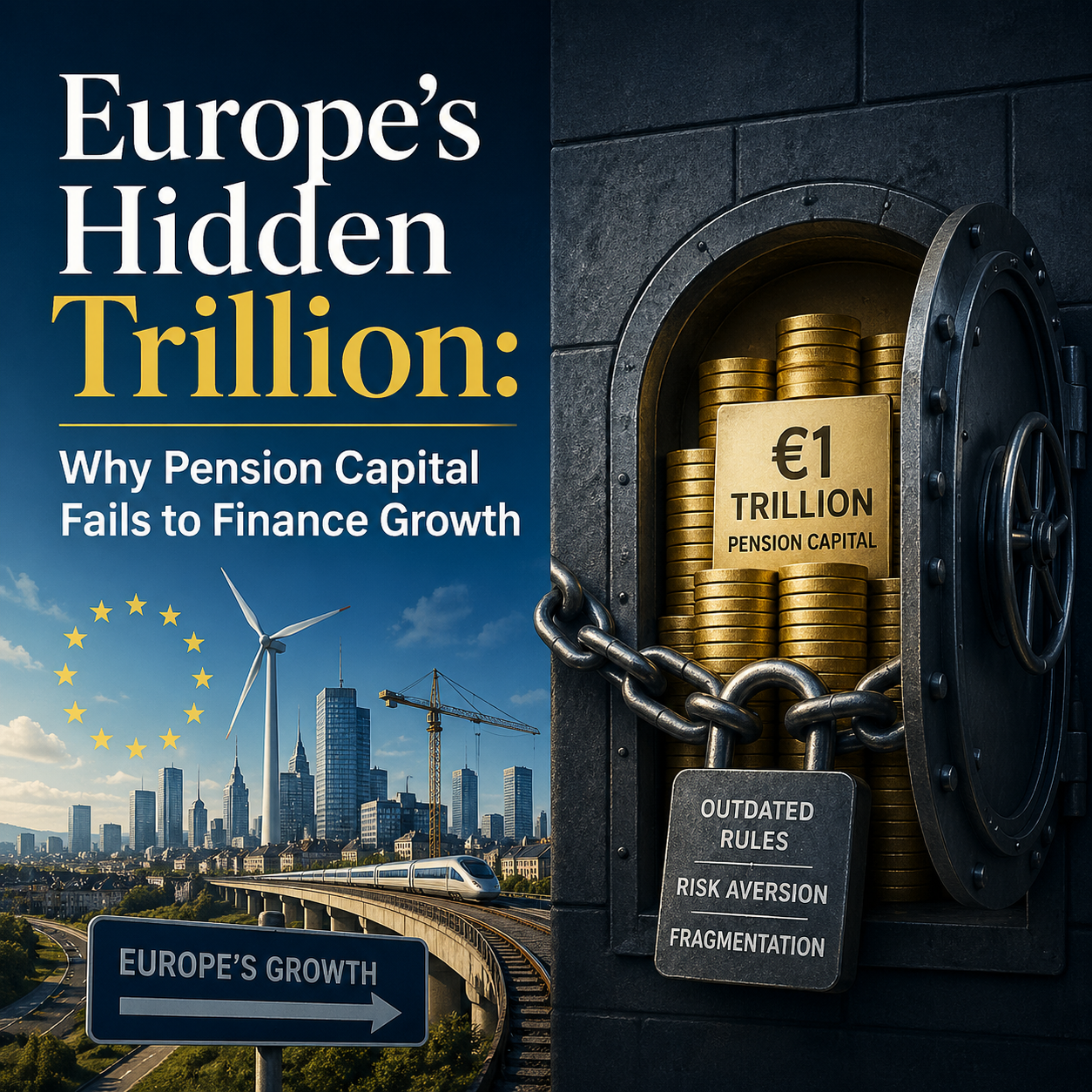
Europe holds over €10 trillion in pension assets, yet much of it fails to support its own economy. Structural conservatism, fragmentation, and regulatory constraints keep capital in low-yield assets or flowing abroad. Unlocking this “hidden trillion” requires rethinking pension investment strategies, scaling funds, and aligning capital with Europe’s long-term growth needs.
Authors

Topics
Article Content
Europe’s Hidden Trillion: Why Pension Capital Fails to Finance Growth
Europe does not have a capital shortage. What it has is a mobilisation problem. At a time when the European Union needs approximately €750–800 billion in additional annual investment to finance the green transition, digital transformation, and its defence priorities — as identified in the Draghi Report on EU Competitiveness — the continent already holds around €10.3 trillion in pension assets. That figure represents roughly 60% of the European Union’s GDP, suggesting a vast pool of resources available for economic growth. In practice, however, a significant share of that capital plays almost no role in the real economy.
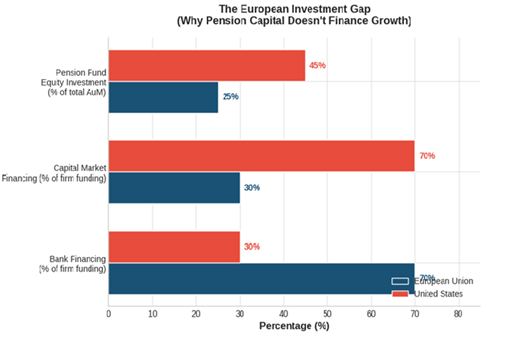
The mismatch stems from how pension funds structure their portfolios. Despite being natural long-term investors, these institutions maintain deeply conservative profiles: roughly 35% of assets are allocated to government bonds, while exposure to infrastructure and private markets sits at just 7%. The result is a concentration of resources in instruments that generate limited economic dynamism.
There is also a clear geographic dimension to the problem. Rather than being deployed within Europe, a substantial volume of capital flows abroad. Dutch pension funds are the clearest example: at end-2024 they held approximately €293 billion in US non-financial corporations, compared to €97 billion in their European equivalents. Europe’s largest long-term investors are, in effect, financing growth elsewhere.
This is a structural consequence of how Europe’s financial system was built. The continent remains dominated by bank-based financing, while capital markets play a secondary role. In the United States, roughly 70% of corporate financing comes through capital markets; in Europe, that same proportion comes from banks. The result is a more constrained environment for risk capital, and more limited access to alternative sources of liquidity for companies that need to grow.
Household savings compound the problem. A large portion of European financial wealth sits in low-yield bank deposits rather than in instruments that channel capital toward investment. This further narrows the pool available for productive use and suppresses the development of local capital market ecosystems.
At the structural root of all this are Europe’s pension systems themselves, which are built predominantly on pay-as-you-go mechanisms: current contributions fund current payments, with limited asset accumulation and therefore limited institutional investor capacity. Regulatory frameworks designed to ensure stability have the unintended effect of encouraging low-risk portfolios and discouraging exposure to more dynamic asset classes.
Fragmentation across member states makes it worse. Different national regulations, weak cross-border integration, and insufficient scale all prevent efficient capital allocation within the Union. Available capital routinely fails to reach the sectors that most need it.
The European Commission’s Savings and Investments Union (SIU) initiative, launched in March 2025, is an attempt to close the gap between European savings and European investment needs. Whether it succeeds will depend not just on regulatory reform but on a deeper shift in how institutional investors perceive and manage risk.
Pension capital is one of Europe’s most underutilised assets. Deploying it effectively could become a key driver of innovation and strategic autonomy. The alternative — continuing to channel European savings into foreign markets — is a choice with real consequences.
1. The Scale of European Pension Capital
1.1 Record Assets, Unrealised Potential
In 2024, European pension funds reached a historic milestone: assets under management (AUM) crossed €10.3 trillion for the first time, according to IPE’s Top 1000 European Pension Funds survey. This reflects 6.2% year-on-year growth and an average annual increase of 5.4% over the past decade — a consistent, long-term expansion of institutional capital in the sector.
The more important question is whether this accumulation is being translated into financing for the real economy. The evidence suggests it largely is not. Assets have grown; productive deployment has not kept pace.
That capital is also heavily concentrated. A handful of markets account for the vast majority of European pension wealth:
Table 1. European pension assets by country (2024)
| Country | Assets (EUR) | Share of Total |
|---|---|---|
| Netherlands | ~€1.6T | 15.5% |
| United Kingdom | ~€1.5T | 14.6% |
| Germany | ~€0.9T | 8.7% |
| France | ~€0.8T | 7.8% |
| Switzerland | ~€0.7T | 6.8% |
| Italy | ~€0.5T | 4.9% |
| Others | ~€4.3T | 41.7% |
Source: IPE Top 1000 European Pension Funds (2025); EIOPA (2024)
This concentration directly shapes investment behaviour. The dominant markets — the Netherlands, UK, Germany and France — set the tone for the sector, and their preference for liquid, low-risk instruments has become the de facto norm across European institutional investment.
1.2 Global Context
Viewed globally, European pension capital is substantial but structurally distinct. According to OECD data for 2024, global pension assets reached approximately $69.8 trillion, with Europe ranking second at approximately $9.7 trillion (roughly €9.7 trillion), well behind North America at $48.2 trillion.
The difference is not simply one of scale. In the United States, pension funds are central participants in capital markets — allocating heavily to equities, private equity, and infrastructure. In Europe, their role remains comparatively passive. European pension capital accumulates; it does not, by and large, deploy.
In terms of investment returns, the picture is broadly positive. OECD data shows that pension providers across member countries achieved an average nominal investment return of 9.1% in 2024, driven largely by equity market performance. The capacity to generate returns is not the constraint. The constraint is where those returns are sought and what they finance.
A key part of the answer lies in the regulatory architecture. The IORP II Directive requires that pension funds invest primarily in regulated markets, while limiting exposure to less liquid assets. The prudential logic is sound, but the practical effect is to discourage investment in the very sectors — large infrastructure projects, private equity, innovative start-ups — that European economies most need to finance. The directive’s cautious framing channels European long-term capital toward static assets and away from productive ones.
This regulatory bias reinforces the geographic investment gap. With few attractive investment-grade instruments available domestically, even the largest European institutional investors turn to overseas markets for yield. The result is that European savings subsidise American growth — not through any malicious intent, but through a combination of structural incentives and market logic. Europe’s pension capital ends up serving its competitors.
1.3 Policy Initiatives and Transformation Models
In March 2025, the European Commission launched the Savings and Investments Union (SIU) strategy, its most substantive attempt yet to link European household and institutional savings to productive investment. The initiative is explicitly framed around the €750–800 billion annual investment gap identified in the 2024 Draghi Report on EU Competitiveness — a gap that spans the green transition, digital infrastructure, and defence.
The SIU’s proposed toolkit includes regulatory simplification to ease portfolio management constraints for funds, greater flexibility for diversification into equities and alternative assets, and a refinement of the “prudent person” principle to make it less of a deterrent to productive investment. These reforms aim to reposition pension capital from passive bond management to active financing of innovation and infrastructure.
The United Kingdom is pursuing a parallel but more directive model: the mega-fund. Under the Pension Schemes Bill, all multi-employer defined contribution schemes will be required to manage at least £25 billion in assets — in a main default arrangement — by 2030, with a transition pathway available for schemes demonstrating a credible plan to reach that threshold by 2035. The government’s stated rationale is that scale creates the capacity to invest in asset classes that smaller funds cannot access. The Local Government Pension Scheme (LGPS), currently split across 86 administering authorities and totalling £392 billion, will be consolidated into just six pools.
The projected evolution of this consolidation is as follows:
Table 2. Projected evolution of UK pension mega-funds
| Period | Mega-funds | Avg. AUM | Est. Unlocked Capital |
|---|---|---|---|
| 2024 (current) | 5 | £25B+ | ~£125B |
| 2030 (target) | 10–15 | ~£42B | £420B–£630B |
| 2035 (projected) | 15–20 | ~£55B | £825B–£1.1T |
Source: UK Government Pensions Investment Review (January 2025). Note: 2030 and 2035 projections are indicative estimates based on announced policy direction; actual outcomes will depend on market conditions and scheme-level decisions.
The UK government estimates that these reforms could unlock over £50 billion for investment in UK infrastructure, housing, and growing businesses. For individual savers, consolidation alone could add approximately £6,000 to the average pension pot at retirement — a tangible benefit that makes the political case for structural change easier to make.
2. Structural Transformation: From Solidarity to an Investment-Oriented Model
Europe is in the middle of a generational shift in how occupational pensions are organised. The long-dominant defined benefit (DB) model — in which employers commit to paying a specified pension regardless of investment outcomes — is being replaced by defined contribution (DC) arrangements, where returns depend on how contributions are invested over time.
According to OECD data, occupational DB plans accounted for 39.7% of all pension plan assets in 2014. By end-2024, that share had fallen to 31.9%. The trajectory is clear, and projections suggest the DB share could fall to around 20% by the end of this decade if current trends continue.
The Netherlands is the most dramatic example. The Future of Pensions Act (Wet toekomst pensioenen — Wtp), which entered into force on 1 July 2023, mandates that all pension funds in the Netherlands transition to a defined contribution model. The deadline for full compliance is 1 January 2028. This is the largest overhaul of the Dutch pension system since the 1950s, affecting roughly 11 million participants.
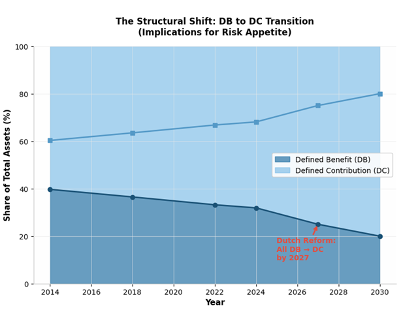
The visual representation of this transition explains why the continent’s investment appetite is changing—DC schemes, by their very nature, require higher returns through more active asset management.
The shift from DB to DC carries significant implications for capital markets. Under defined benefit arrangements, pension funds immunise their long-term liabilities through extensive holdings of government bonds and interest rate derivatives — creating a structural, price-insensitive buyer of long-duration instruments. As DB schemes wind down, that demand disappears. In its place, DC schemes require active return-seeking strategies, which naturally pull capital toward equities, alternatives, and higher-yield assets. The European Central Bank has noted that the DB-to-DC transition is likely to reduce demand for long-term bonds while increasing equity investment — a natural mechanism for redirecting capital into the European real economy.
Asset Allocation and the Path to Productive Investment
The current allocation of assets held by European Institutions for Occupational Retirement Provision (IORPs) amounts to approximately €2.7 trillion. Based on EIOPA’s 2024 data, those assets remain heavily weighted toward fixed income and low-risk instruments:
Table 3. Asset allocation: current vs. SIU target
| Asset Class | Current Allocation | SIU Target |
|---|---|---|
| Government bonds | 35% | 20% |
| Corporate bonds | 18% | 15% |
| Equities | 25% | 30% |
| Investment funds | 15% | 20% |
| Alternatives (infra, private equity) | 7% | 15% |
Source: EIOPA (2024); European Commission SIU Strategy (2025)
The most consequential shift in the SIU framework is the proposed reduction in government bond holdings from 35% to 20%, with the freed-up capital redirected toward equities, investment funds, and — most critically — alternatives including infrastructure and private equity, from 7% to a target of 15%.
This reallocation matters for two reasons. First, it would provide much-needed patient capital for long-cycle projects — energy infrastructure, transport networks, deep-tech investment — that cannot rely on short-term market financing. Second, it would improve returns for beneficiaries: alternative assets and private equity have historically delivered significantly higher long-term returns than government securities, though with greater complexity and less liquidity.
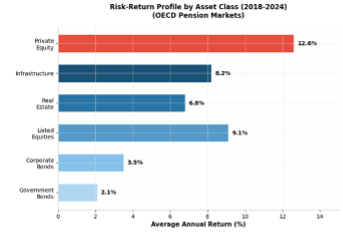
In the context of the Draghi Report, mobilising this capital is not a supplementary policy option — it is one of the few levers large enough to meaningfully address Europe’s investment gap without requiring equivalent increases in public expenditure.
3. Challenges to Systemic Transformation
The obstacles to change are not primarily ideological. They are structural, institutional, and, in some cases, unavoidably practical.
Fragmentation is the most persistent problem. As of end-2023, approximately 1,419 pension funds operate within the European Economic Area. While that number has declined by roughly 5% over the previous three years, consolidation has been slow relative to what meaningful scale requires. Smaller funds lack the internal capacity for direct infrastructure investment, private equity participation, or complex long-term asset management. They also lack negotiating leverage with asset managers and the analytical resources to conduct adequate due diligence on alternative assets. The absence of scale is not merely an operational inconvenience — it is a structural barrier that keeps pension capital trapped in conventional instruments.
Even where regulatory conditions permit broader investment, the internal capacity to act on that freedom is often absent. Infrastructure, private equity, and venture capital all require specialised teams, sophisticated risk models, and the institutional knowledge to manage assets over multi-decade horizons. These capabilities take years to build. Many European pension funds, particularly smaller ones, simply do not have them. When policy reform loosens the rules, the result is often not a surge of productive investment but a continuation of cautious behaviour — because the expertise to do otherwise does not exist.
Regulatory uncertainty compounds the problem. The “prudent person” principle, embedded in the IORP II framework, provides theoretical flexibility, but its interpretation varies substantially across member states. In some jurisdictions it is read narrowly, effectively discouraging any deviation from conventional bond portfolios. In others it is read more permissively. This inconsistency creates an uneven playing field, inhibits cross-border investment, and undermines the coherence of the European capital market.
4. Strategic Pathways and Priorities
Addressing these challenges requires more than policy ambition. It requires institutional reform that is sequenced, credible, and tied to specific outcomes.
The question of scale is unavoidable. Analysis from the UK government suggests that approximately £50 billion represents the threshold at which funds can realistically diversify into long-term and illiquid assets — not as a nice-to-have, but as a viable strategy. Europe’s model of hundreds of small funds does not meet that threshold. Direct consolidation is one path, but it faces institutional and political resistance. An alternative is the Outsourced Chief Investment Officer (OCIO) model, which allows smaller funds to pool expertise and achieve investment-scale outcomes while retaining legal independence. This approach has grown in the UK and Australia, and deserves serious consideration in Europe.
Regulatory clarity is equally critical. The SIU will only deliver if the interpretation of the prudent person principle is harmonised across member states. Clearer guidance on alternative asset investment, consistent standards for infrastructure financing, and a reduced compliance burden for cross-border allocation would together remove the main practical barriers to redeployment. Without this, even well-intentioned funds face too much legal uncertainty to act.
There is also a broader question of investment orientation. The UK’s Mansion House Accord, under which 17 major pension providers voluntarily committed to allocating 10% of default fund assets to private markets by 2030 — with at least 5% in UK assets — demonstrates that domestic investment benchmarks can work without being punitive. A comparable approach at EU level — not mandatory quotas, but strategic benchmarks that incentivise investment in European projects — would help align the interests of pension capital with the continent’s investment needs, without compromising fund independence or fiduciary duty.
The debate over European pension capital has always been, at its core, a debate about economic model. For decades, the continent’s financial architecture was deliberately built for stability: predictable returns, liquid assets, minimal exposure to economic cycles. That model made sense in periods of relative calm. In the era of decarbonisation, digitalisation, and renewed geopolitical competition, it is a liability.
The central challenge now is not creating new capital — Europe has plenty of it. The challenge is rethinking the role of capital that already exists. That means changing the regulatory framework, yes. But it also means changing the investment culture: moving from passive preservation to active generation of economic value.
The stakes are significant. Europe’s ability to build an environment where long-term capital drives innovation is directly tied to its strategic autonomy. Without it, the continent does not merely forgo growth — it deepens its dependence on external markets and foreign financing models. European pension savers fund American innovation. European infrastructure decays. European start-ups relocate.
The capital exists. The question is whether Europe will build the system to use it.
References & Sources
1. IPE Top 1000 European Pension Funds 2025 — ipe.com
2. OECD Pension Markets in Focus 2025 — oecd.org
3. De Nederlandsche Bank (DNB): Dutch pension fund investment statistics, end-2024
4. European Commission, Savings and Investments Union Strategy (March 2025)
5. Mario Draghi, The Future of European Competitiveness (September 2024)
6. EIOPA IORP II Directive and IORPS in Focus Report 2024
7. UK Government Pensions Investment Review — Final Report (January 2025)
8. UK Pension Schemes Bill: Scale and Consolidation (2025)
9. Goldman Sachs Asset Management: Pension Fund Assets in the Spotlight (2025)
10. PensionsEurope Report 2024 — Trends and Developments in Funded Pensions
11. Dutch Future Pensions Act (Wtp), entered into force 1 July 2023; full compliance deadline 1 January 2028
Article Content
Europe’s Hidden Trillion: Why Pension Capital Fails to Finance Growth
Europe does not have a capital shortage. What it has is a mobilisation problem. At a time when the European Union needs approximately €750–800 billion in additional annual investment to finance the green transition, digital transformation, and its defence priorities — as identified in the Draghi Report on EU Competitiveness — the continent already holds around €10.3 trillion in pension assets. That figure represents roughly 60% of the European Union’s GDP, suggesting a vast pool of resources available for economic growth. In practice, however, a significant share of that capital plays almost no role in the real economy.
The mismatch stems from how pension funds structure their portfolios. Despite being natural long-term investors, these institutions maintain deeply conservative profiles: roughly 35% of assets are allocated to government bonds, while exposure to infrastructure and private markets sits at just 7%. The result is a concentration of resources in instruments that generate limited economic dynamism.
There is also a clear geographic dimension to the problem. Rather than being deployed within Europe, a substantial volume of capital flows abroad. Dutch pension funds are the clearest example: at end-2024 they held approximately €293 billion in US non-financial corporations, compared to €97 billion in their European equivalents. Europe’s largest long-term investors are, in effect, financing growth elsewhere.
This is a structural consequence of how Europe’s financial system was built. The continent remains dominated by bank-based financing, while capital markets play a secondary role. In the United States, roughly 70% of corporate financing comes through capital markets; in Europe, that same proportion comes from banks. The result is a more constrained environment for risk capital, and more limited access to alternative sources of liquidity for companies that need to grow.
Household savings compound the problem. A large portion of European financial wealth sits in low-yield bank deposits rather than in instruments that channel capital toward investment. This further narrows the pool available for productive use and suppresses the development of local capital market ecosystems.
At the structural root of all this are Europe’s pension systems themselves, which are built predominantly on pay-as-you-go mechanisms: current contributions fund current payments, with limited asset accumulation and therefore limited institutional investor capacity. Regulatory frameworks designed to ensure stability have the unintended effect of encouraging low-risk portfolios and discouraging exposure to more dynamic asset classes.
Fragmentation across member states makes it worse. Different national regulations, weak cross-border integration, and insufficient scale all prevent efficient capital allocation within the Union. Available capital routinely fails to reach the sectors that most need it.
The European Commission’s Savings and Investments Union (SIU) initiative, launched in March 2025, is an attempt to close the gap between European savings and European investment needs. Whether it succeeds will depend not just on regulatory reform but on a deeper shift in how institutional investors perceive and manage risk.
Pension capital is one of Europe’s most underutilised assets. Deploying it effectively could become a key driver of innovation and strategic autonomy. The alternative — continuing to channel European savings into foreign markets — is a choice with real consequences.
1. The Scale of European Pension Capital
1.1 Record Assets, Unrealised Potential
In 2024, European pension funds reached a historic milestone: assets under management (AUM) crossed €10.3 trillion for the first time, according to IPE’s Top 1000 European Pension Funds survey. This reflects 6.2% year-on-year growth and an average annual increase of 5.4% over the past decade — a consistent, long-term expansion of institutional capital in the sector.
The more important question is whether this accumulation is being translated into financing for the real economy. The evidence suggests it largely is not. Assets have grown; productive deployment has not kept pace.
That capital is also heavily concentrated. A handful of markets account for the vast majority of European pension wealth:
Table 1. European pension assets by country (2024)
| Country | Assets (EUR) | Share of Total |
|---|---|---|
| Netherlands | ~€1.6T | 15.5% |
| United Kingdom | ~€1.5T | 14.6% |
| Germany | ~€0.9T | 8.7% |
| France | ~€0.8T | 7.8% |
| Switzerland | ~€0.7T | 6.8% |
| Italy | ~€0.5T | 4.9% |
| Others | ~€4.3T | 41.7% |
Source: IPE Top 1000 European Pension Funds (2025); EIOPA (2024)
This concentration directly shapes investment behaviour. The dominant markets — the Netherlands, UK, Germany and France — set the tone for the sector, and their preference for liquid, low-risk instruments has become the de facto norm across European institutional investment.
1.2 Global Context
Viewed globally, European pension capital is substantial but structurally distinct. According to OECD data for 2024, global pension assets reached approximately $69.8 trillion, with Europe ranking second at approximately $9.7 trillion (roughly €9.7 trillion), well behind North America at $48.2 trillion.
The difference is not simply one of scale. In the United States, pension funds are central participants in capital markets — allocating heavily to equities, private equity, and infrastructure. In Europe, their role remains comparatively passive. European pension capital accumulates; it does not, by and large, deploy.
In terms of investment returns, the picture is broadly positive. OECD data shows that pension providers across member countries achieved an average nominal investment return of 9.1% in 2024, driven largely by equity market performance. The capacity to generate returns is not the constraint. The constraint is where those returns are sought and what they finance.
A key part of the answer lies in the regulatory architecture. The IORP II Directive requires that pension funds invest primarily in regulated markets, while limiting exposure to less liquid assets. The prudential logic is sound, but the practical effect is to discourage investment in the very sectors — large infrastructure projects, private equity, innovative start-ups — that European economies most need to finance. The directive’s cautious framing channels European long-term capital toward static assets and away from productive ones.
This regulatory bias reinforces the geographic investment gap. With few attractive investment-grade instruments available domestically, even the largest European institutional investors turn to overseas markets for yield. The result is that European savings subsidise American growth — not through any malicious intent, but through a combination of structural incentives and market logic. Europe’s pension capital ends up serving its competitors.
1.3 Policy Initiatives and Transformation Models
In March 2025, the European Commission launched the Savings and Investments Union (SIU) strategy, its most substantive attempt yet to link European household and institutional savings to productive investment. The initiative is explicitly framed around the €750–800 billion annual investment gap identified in the 2024 Draghi Report on EU Competitiveness — a gap that spans the green transition, digital infrastructure, and defence.
The SIU’s proposed toolkit includes regulatory simplification to ease portfolio management constraints for funds, greater flexibility for diversification into equities and alternative assets, and a refinement of the “prudent person” principle to make it less of a deterrent to productive investment. These reforms aim to reposition pension capital from passive bond management to active financing of innovation and infrastructure.
The United Kingdom is pursuing a parallel but more directive model: the mega-fund. Under the Pension Schemes Bill, all multi-employer defined contribution schemes will be required to manage at least £25 billion in assets — in a main default arrangement — by 2030, with a transition pathway available for schemes demonstrating a credible plan to reach that threshold by 2035. The government’s stated rationale is that scale creates the capacity to invest in asset classes that smaller funds cannot access. The Local Government Pension Scheme (LGPS), currently split across 86 administering authorities and totalling £392 billion, will be consolidated into just six pools.
The projected evolution of this consolidation is as follows:
Table 2. Projected evolution of UK pension mega-funds
| Period | Mega-funds | Avg. AUM | Est. Unlocked Capital |
|---|---|---|---|
| 2024 (current) | 5 | £25B+ | ~£125B |
| 2030 (target) | 10–15 | ~£42B | £420B–£630B |
| 2035 (projected) | 15–20 | ~£55B | £825B–£1.1T |
Source: UK Government Pensions Investment Review (January 2025). Note: 2030 and 2035 projections are indicative estimates based on announced policy direction; actual outcomes will depend on market conditions and scheme-level decisions.
The UK government estimates that these reforms could unlock over £50 billion for investment in UK infrastructure, housing, and growing businesses. For individual savers, consolidation alone could add approximately £6,000 to the average pension pot at retirement — a tangible benefit that makes the political case for structural change easier to make.
2. Structural Transformation: From Solidarity to an Investment-Oriented Model
Europe is in the middle of a generational shift in how occupational pensions are organised. The long-dominant defined benefit (DB) model — in which employers commit to paying a specified pension regardless of investment outcomes — is being replaced by defined contribution (DC) arrangements, where returns depend on how contributions are invested over time.
According to OECD data, occupational DB plans accounted for 39.7% of all pension plan assets in 2014. By end-2024, that share had fallen to 31.9%. The trajectory is clear, and projections suggest the DB share could fall to around 20% by the end of this decade if current trends continue.
The Netherlands is the most dramatic example. The Future of Pensions Act (Wet toekomst pensioenen — Wtp), which entered into force on 1 July 2023, mandates that all pension funds in the Netherlands transition to a defined contribution model. The deadline for full compliance is 1 January 2028. This is the largest overhaul of the Dutch pension system since the 1950s, affecting roughly 11 million participants.
The visual representation of this transition explains why the continent’s investment appetite is changing—DC schemes, by their very nature, require higher returns through more active asset management.
The shift from DB to DC carries significant implications for capital markets. Under defined benefit arrangements, pension funds immunise their long-term liabilities through extensive holdings of government bonds and interest rate derivatives — creating a structural, price-insensitive buyer of long-duration instruments. As DB schemes wind down, that demand disappears. In its place, DC schemes require active return-seeking strategies, which naturally pull capital toward equities, alternatives, and higher-yield assets. The European Central Bank has noted that the DB-to-DC transition is likely to reduce demand for long-term bonds while increasing equity investment — a natural mechanism for redirecting capital into the European real economy.
Asset Allocation and the Path to Productive Investment
The current allocation of assets held by European Institutions for Occupational Retirement Provision (IORPs) amounts to approximately €2.7 trillion. Based on EIOPA’s 2024 data, those assets remain heavily weighted toward fixed income and low-risk instruments:
Table 3. Asset allocation: current vs. SIU target
| Asset Class | Current Allocation | SIU Target |
|---|---|---|
| Government bonds | 35% | 20% |
| Corporate bonds | 18% | 15% |
| Equities | 25% | 30% |
| Investment funds | 15% | 20% |
| Alternatives (infra, private equity) | 7% | 15% |
Source: EIOPA (2024); European Commission SIU Strategy (2025)
The most consequential shift in the SIU framework is the proposed reduction in government bond holdings from 35% to 20%, with the freed-up capital redirected toward equities, investment funds, and — most critically — alternatives including infrastructure and private equity, from 7% to a target of 15%.
This reallocation matters for two reasons. First, it would provide much-needed patient capital for long-cycle projects — energy infrastructure, transport networks, deep-tech investment — that cannot rely on short-term market financing. Second, it would improve returns for beneficiaries: alternative assets and private equity have historically delivered significantly higher long-term returns than government securities, though with greater complexity and less liquidity.
In the context of the Draghi Report, mobilising this capital is not a supplementary policy option — it is one of the few levers large enough to meaningfully address Europe’s investment gap without requiring equivalent increases in public expenditure.
3. Challenges to Systemic Transformation
The obstacles to change are not primarily ideological. They are structural, institutional, and, in some cases, unavoidably practical.
Fragmentation is the most persistent problem. As of end-2023, approximately 1,419 pension funds operate within the European Economic Area. While that number has declined by roughly 5% over the previous three years, consolidation has been slow relative to what meaningful scale requires. Smaller funds lack the internal capacity for direct infrastructure investment, private equity participation, or complex long-term asset management. They also lack negotiating leverage with asset managers and the analytical resources to conduct adequate due diligence on alternative assets. The absence of scale is not merely an operational inconvenience — it is a structural barrier that keeps pension capital trapped in conventional instruments.
Even where regulatory conditions permit broader investment, the internal capacity to act on that freedom is often absent. Infrastructure, private equity, and venture capital all require specialised teams, sophisticated risk models, and the institutional knowledge to manage assets over multi-decade horizons. These capabilities take years to build. Many European pension funds, particularly smaller ones, simply do not have them. When policy reform loosens the rules, the result is often not a surge of productive investment but a continuation of cautious behaviour — because the expertise to do otherwise does not exist.
Regulatory uncertainty compounds the problem. The “prudent person” principle, embedded in the IORP II framework, provides theoretical flexibility, but its interpretation varies substantially across member states. In some jurisdictions it is read narrowly, effectively discouraging any deviation from conventional bond portfolios. In others it is read more permissively. This inconsistency creates an uneven playing field, inhibits cross-border investment, and undermines the coherence of the European capital market.
4. Strategic Pathways and Priorities
Addressing these challenges requires more than policy ambition. It requires institutional reform that is sequenced, credible, and tied to specific outcomes.
The question of scale is unavoidable. Analysis from the UK government suggests that approximately £50 billion represents the threshold at which funds can realistically diversify into long-term and illiquid assets — not as a nice-to-have, but as a viable strategy. Europe’s model of hundreds of small funds does not meet that threshold. Direct consolidation is one path, but it faces institutional and political resistance. An alternative is the Outsourced Chief Investment Officer (OCIO) model, which allows smaller funds to pool expertise and achieve investment-scale outcomes while retaining legal independence. This approach has grown in the UK and Australia, and deserves serious consideration in Europe.
Regulatory clarity is equally critical. The SIU will only deliver if the interpretation of the prudent person principle is harmonised across member states. Clearer guidance on alternative asset investment, consistent standards for infrastructure financing, and a reduced compliance burden for cross-border allocation would together remove the main practical barriers to redeployment. Without this, even well-intentioned funds face too much legal uncertainty to act.
There is also a broader question of investment orientation. The UK’s Mansion House Accord, under which 17 major pension providers voluntarily committed to allocating 10% of default fund assets to private markets by 2030 — with at least 5% in UK assets — demonstrates that domestic investment benchmarks can work without being punitive. A comparable approach at EU level — not mandatory quotas, but strategic benchmarks that incentivise investment in European projects — would help align the interests of pension capital with the continent’s investment needs, without compromising fund independence or fiduciary duty.
The debate over European pension capital has always been, at its core, a debate about economic model. For decades, the continent’s financial architecture was deliberately built for stability: predictable returns, liquid assets, minimal exposure to economic cycles. That model made sense in periods of relative calm. In the era of decarbonisation, digitalisation, and renewed geopolitical competition, it is a liability.
The central challenge now is not creating new capital — Europe has plenty of it. The challenge is rethinking the role of capital that already exists. That means changing the regulatory framework, yes. But it also means changing the investment culture: moving from passive preservation to active generation of economic value.
The stakes are significant. Europe’s ability to build an environment where long-term capital drives innovation is directly tied to its strategic autonomy. Without it, the continent does not merely forgo growth — it deepens its dependence on external markets and foreign financing models. European pension savers fund American innovation. European infrastructure decays. European start-ups relocate.
The capital exists. The question is whether Europe will build the system to use it.
References & Sources
1. IPE Top 1000 European Pension Funds 2025 — ipe.com
2. OECD Pension Markets in Focus 2025 — oecd.org
3. De Nederlandsche Bank (DNB): Dutch pension fund investment statistics, end-2024
4. European Commission, Savings and Investments Union Strategy (March 2025)
5. Mario Draghi, The Future of European Competitiveness (September 2024)
6. EIOPA IORP II Directive and IORPS in Focus Report 2024
7. UK Government Pensions Investment Review — Final Report (January 2025)
8. UK Pension Schemes Bill: Scale and Consolidation (2025)
9. Goldman Sachs Asset Management: Pension Fund Assets in the Spotlight (2025)
10. PensionsEurope Report 2024 — Trends and Developments in Funded Pensions
11. Dutch Future Pensions Act (Wtp), entered into force 1 July 2023; full compliance deadline 1 January 2028