Capital for the Future: At the Heart of Europe’s Transformation
Capital for the Future: At the Heart of Europe’s Transformation
This document explores the European Union's strategic shift toward transforming capital access. It highlights the structural problem where SMEs rely too heavily on bank financing and suggests mobilizing over €10 trillion in "idle" household savings to fuel innovation and strategic autonomy.
Authors

Topics
Article Content
"Investments in innovation, growth and quality jobs are not merely an economic goal – they are a reflection of our ambition for a sovereign, sustainable and competitive European Union."
— Ursula von der Leyen, March 2025, President of the European Commission
Introduction: The Capital Access Challenge
In a world where global economic dynamics are being reshaped, technologies are evolving at an exponential pace, and challenges such as the climate crisis and geopolitical uncertainty are forcing countries into a state of constant adaptation, access to capital emerges as a fundamental resource—not only for economic development but also for strategic autonomy. It is in this context that the European Union realizes it can no longer afford to maintain a system in which tens of thousands of innovative companies, startups, and high-tech sectors are left without the necessary resources to unlock their full potential.
The problem is deeply structural: small and medium-sized enterprises (SMEs), which make up over 99% of all businesses in the EU and form the backbone of its economy, often rely almost entirely on bank financing. However, banking channels are limited, costly, and risk-averse—especially during periods of rising interest rates or economic uncertainty. As a result, the continent's creative and entrepreneurial potential remains partially blocked—at a time when the world is betting on innovation, green technologies, and digital connectivity as key levers for prosperity.
At the same time, the EU holds enormous reserves of "idle capital"—more than €10 trillion concentrated in household bank deposits. These funds, while safe, yield low returns and fail to fuel the real economy. On one side are people with accumulated savings, worried about risk and often unaware of the opportunities offered by capital markets; on the other—industries of the future, in need of fresh capital but unable to access it. Between them lies a gap that EU institutions can no longer afford to ignore.
This is precisely why, in March 2025, the European Commission presented a new strategic framework aimed not merely at supporting economic financing but at transforming the very logic of capital access in the Union. These new measures are seamlessly embedded within the long-term vision of initiatives such as the Savings and Investment Union (SSI) and Capital Markets Union 2.0, which seek to build truly integrated and accessible financial markets.
A Cultural and Economic Transformation
This is a transformation not only in economic terms but also in cultural ones. It demands a new mindset, where investing is no longer a privilege reserved for institutional players but a tool for the economic participation of every citizen. The European Commission is betting on digitalization, tax incentives, platform-based innovation, and improved regulation to connect savers with entrepreneurs, ideas with resources, and needs with solutions.
At the core of this new model lies a firm message: access to capital is the key to European competitiveness, social cohesion, and strategic autonomy. If this access is not guaranteed for SMEs and critical sectors—the ones that will shape the future of the EU—then even the most ambitious policies will lack an economic backbone.
Today, more than ever, it is time to open the floodgates of financing. Not because it looks good on paper, but because it is the only way Europe can be competitive—not tomorrow, but right now.
The Structural Challenge: SMEs and Capital Access
One of the most serious structural challenges to the competitiveness and sustainable growth of the European Union is the chronic lack of effective access to capital for small and medium-sized enterprises (SMEs), as well as for key innovation sectors such as green energy, digital security, and semiconductor manufacturing. Although SMEs form the backbone of the European economy—generating over 50% of the EU's GDP and providing jobs for approximately 100 million people—they continue to rely heavily on bank lending, which makes them particularly vulnerable in times of tight monetary policy and rising interest rates.
The existing investment model in the EU is fragmented and imbalanced. The dominance of low-risk, low-yield instruments in the portfolios of households and institutional investors leads to missed opportunities—not only for savers but also for the growth of the real economy.
Regional Disparities in Capital Market Participation
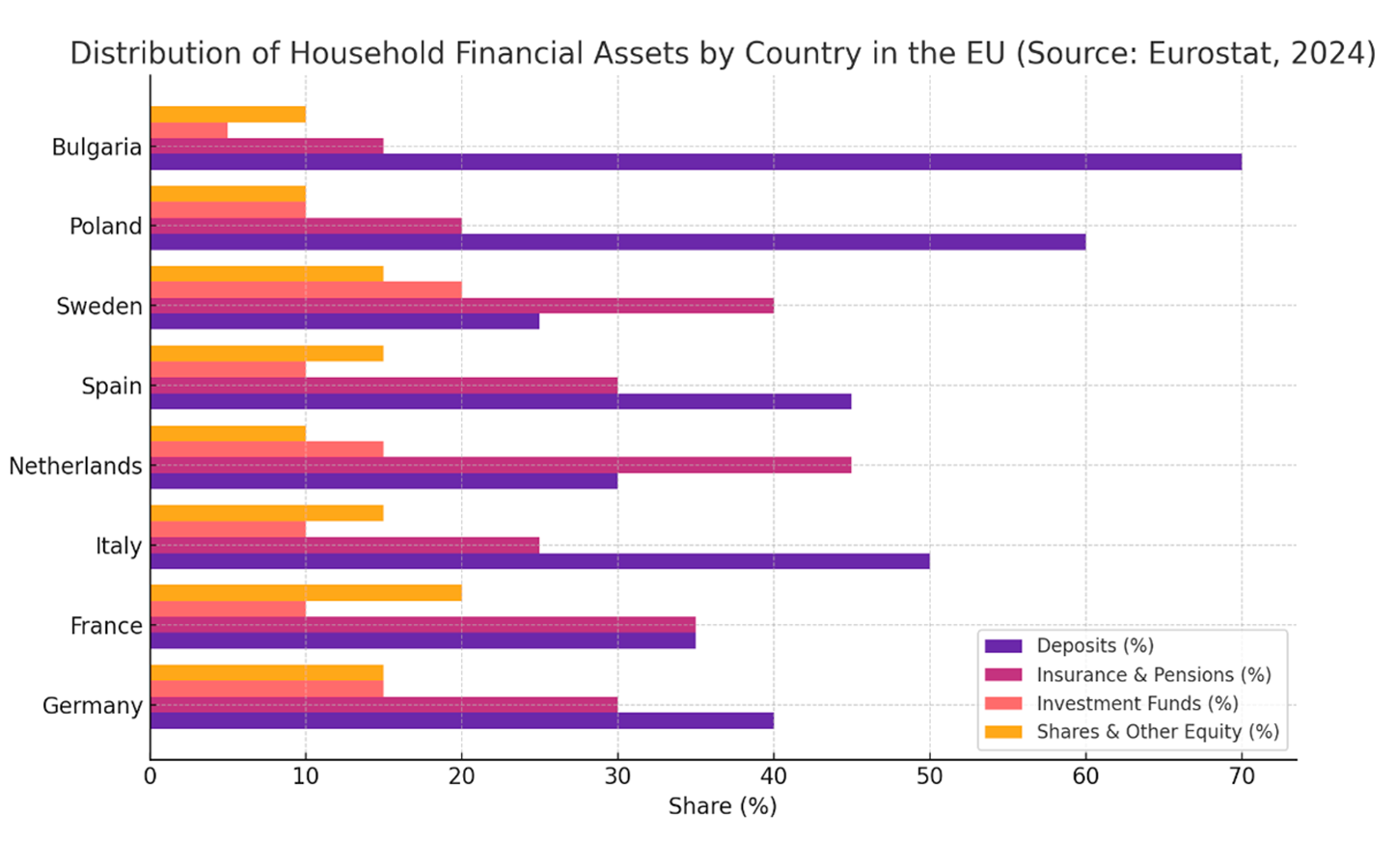
According to Eurostat data from 2024:
- Bulgaria: 70% of household financial assets are in deposits
- Poland: 60% of household financial assets are in deposits
- Sweden and Netherlands: Higher levels of diversification with larger shares of pension and investment products
This discrepancy is symptomatic of deeper structural and institutional barriers. The EU still lacks an integrated ecosystem that encourages the flow of capital from savings into innovative, high-risk, but also high-return enterprises. Less than 15% of venture capital in Europe is directed toward startups outside of traditional hubs such as Germany, France, and Sweden, while southern and eastern parts of the continent remain in the shadows.
The low participation of retail investors further complicates the situation. Data from the European Commission shows that only about 12% of EU households directly invest in capital markets, compared to 40% in the United States.
Capital Shortfall by Sector
Data from the European Investment Bank (EIB) and Eurostat for 2024 confirm the existence of significant capital deficits, particularly affecting emerging yet critically important industries:
| Sector | Capital Shortfall (%) |
|---|---|
| Green Energy | 42% |
| Semiconductors | 38% |
| Cybersecurity | 35% |
| Biotechnology | 33% |
| Artificial Intelligence | 30% |
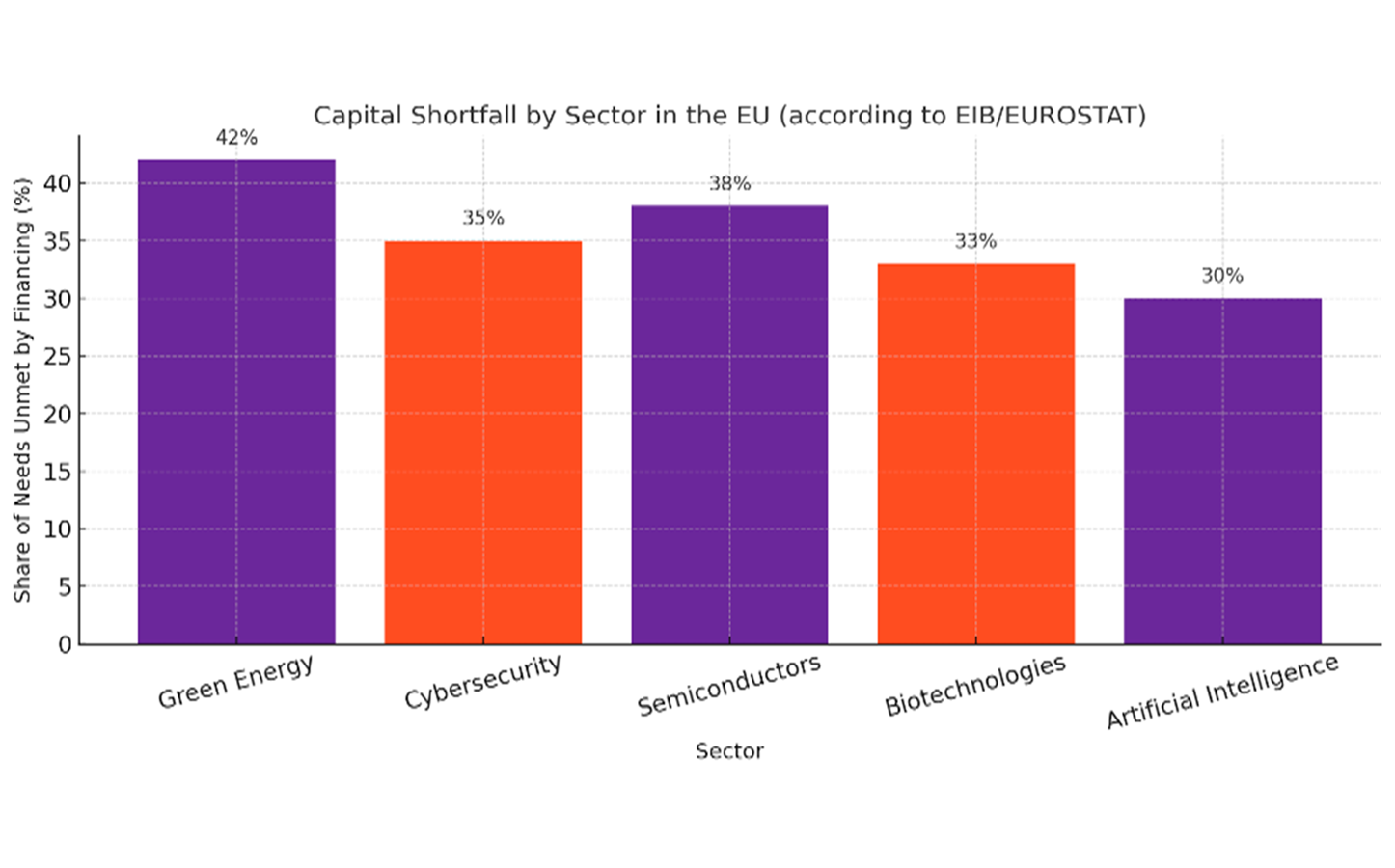
The causes of this shortfall are multifaceted: limited participation of institutional investors in high-risk assets, lack of specialized funds for long-term technologies, high degree of regulatory fragmentation in EU capital markets, and a significant information gap between investors and entrepreneurs.
The European Commission's Response: 2025 Investment Toolkit
In 2025, the European Commission is making a decisive shift toward accelerated capital mobilization by launching a new investment toolkit aimed at overcoming long-standing structural obstacles to financing within the European Union.
1. European Equity Investment Platform for SMEs
The creation of a European Equity Investment Platform for SMEs is among the most significant innovations. The platform functions as a digital hub, bringing together public and private sources of capital and offering a standardized framework for SME investments across the EU.
Key Features:
- Unified investment space: Enterprises connect with individual and institutional investors in a transparent environment
- Automated risk assessment: Machine learning algorithms classify projects by sector, development stage, innovation potential, and return profile
- Low entry threshold: Investments can begin at accessible levels, open to both institutions and citizens
- Integrated portfolio management: Personalized recommendations based on risk profile, ESG preferences, or sectoral interest
- Tax incentive integration: Automatic linking to reduced taxation of capital gains, tax credits, or deferred taxation for long-term investing
- ESG certification: Investors can see compliance with environmental, social, and governance criteria
- Cross-border functionality: Citizens from one country can invest easily in businesses from another
2. Strategic Autonomy Funds
The European Commission has established specialized Strategic Autonomy Funds focused on directing capital flows toward industries vital for the EU's long-term sustainability, technological independence, and geopolitical stability.
Based on the Net-Zero Industry Act (NZIA), these funds support:
- Solar and wind energy
- Green hydrogen infrastructure
- Energy storage systems (batteries)
- Carbon capture and storage
- Digital cybersecurity
Blended Finance Model:
The funds are financed through blended finance—combining public funds from the EU, instruments of the European Investment Bank (EIB), and private investors. The creation of "first-loss" tranches by the EIB means that in the event of losses, the public component absorbs the initial hit, leaving private investors in a more protected position.
3. Public-Private Co-Investment Mechanisms
Among the most innovative financial mechanisms is the creation of Public-Private Co-Investment Mechanisms—instruments for joint investment aimed at overcoming structural barriers to investment in startups and high-value-added infrastructure projects.
At the core of this model lies the logic of the "green financial guarantee"—public institutions take on the initial risk by securing part of the invested capital against potential losses, allowing private investors to participate in projects with higher uncertainty but substantial impact potential.
These mechanisms are already showing promising results through pilot implementation within:
- Horizon Europe: European Innovation Council (EIC) provides equity or convertible loans combined with grants
- InvestEU: Cross-border standardization for transnational projects
4. Tax Incentives for Venture Capital
Starting in 2025, new tax incentives focus on investments in startups, green technologies, and digital infrastructure. The EU is introducing lower taxes on capital gains and dividends for investments in innovation.
Successful Examples:
- France: "Madelin" tax reliefs allow part of invested sums to be deducted from personal income tax
- Netherlands: SEED Capital model creates sustainable environment for joint state-private investment
The Commission is also working on territorial targeting of tax incentives—prioritizing tax relief for investments in regions lagging in growth or access to financing.
5. Single Passport Framework for Investment Platforms
In 2025, the European Commission introduces a single passport framework for investment platforms—a regulatory "accelerator" designed to clear the way for cross-border investments across the Union.
If a platform for crowdfunding, robo-advisory services, or peer-to-peer lending receives a license in one Member State, it can then operate freely across all others without facing national regulatory barriers.
EU Investment Tools 2025: Summary Table
| Instrument | Budget/Support (2025) | Scope | Target Effect |
|---|---|---|---|
| European Equity Investment Platform for SMEs | €10 billion (EU + EIB + private funds) | SMEs in all growth-potential sectors | Facilitate equity access and reduce admin burden |
| Strategic Autonomy Funds (Net-Zero Industry Act) | €30 billion by 2027 | Green tech, batteries, hydrogen, digital networks | Support strategic autonomy and green transition |
| Public-Private Co-Investment Mechanisms | €15 billion (co-financing) | Startups, infrastructure, AI, biotech | Encourage early-stage funding and risk-sharing |
| Tax Incentives for Venture Capital | National tax regimes + EU recommendations | Investors in startups, green and digital assets | Boost investment activity and mobilize private capital |
| Single Passport Framework for Investment Platforms | Regulatory framework – no direct budget | Entire EU – cross-border access to fintech platforms | Democratize investments and stimulate innovation |
The European Digital Finance Gateway
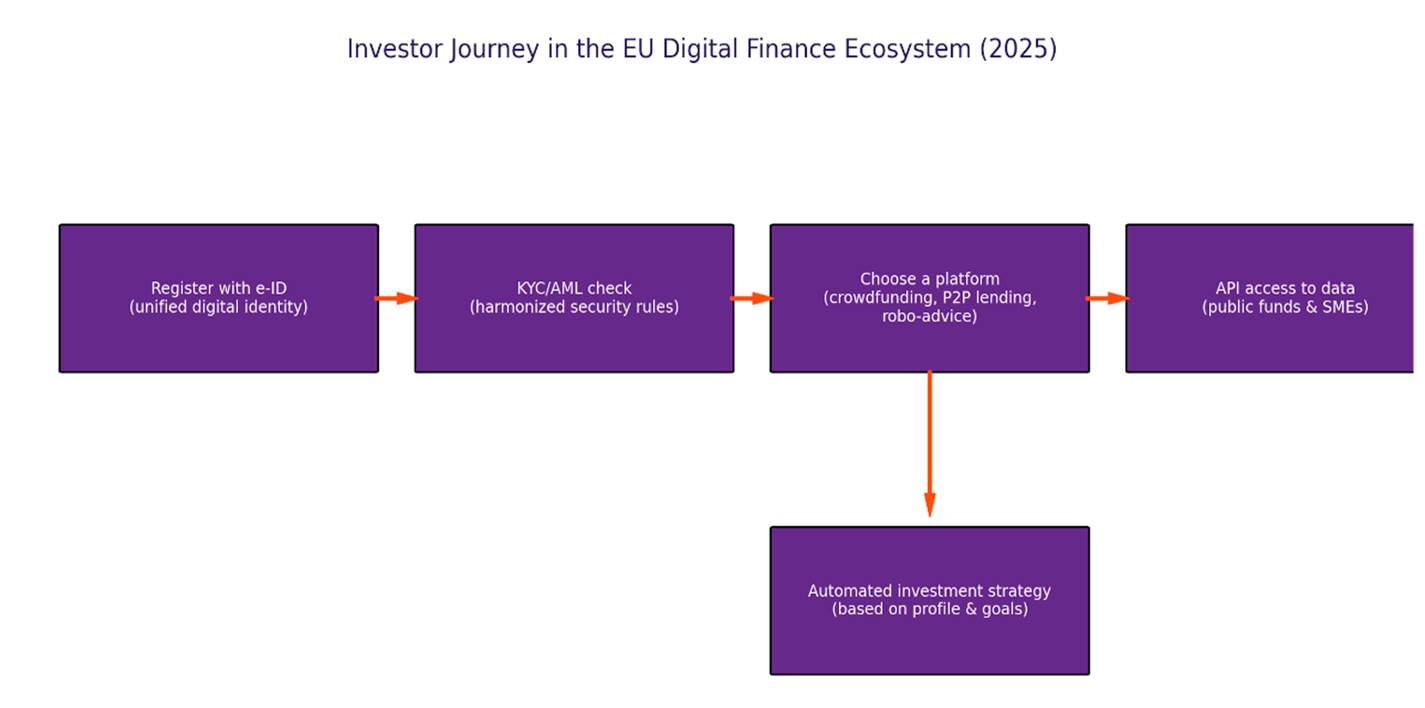
The European Commission is actively working on the development of the European Digital Finance Gateway—a platform designed to digitalize access to financing.
Core Components:
- Unified electronic identity (e-ID): Replaces complex and fragmented identification procedures with a single, easy-to-use digital profile
- Harmonized KYC/AML rules: Facilitates access to investment platforms while enhancing security
- Open interfaces (APIs): Real-time access to data on public funds, available financing, and investment opportunities in SMEs
- Automated personalized investment profiles: Aligns investor preferences with real economy needs
Investment Gaps and Targets
Green Technologies
According to the European Court of Auditors (2024), Europe must increase annual investments in green technologies by approximately €390 billion by 2030 to meet climate commitments under the Green Deal and Fit for 55 package.
The Strategic Autonomy Funds are channeling €30 billion by 2027, expected to exceed €60 billion by 2030 with private co-financing. At least 30% of mobilized capital will be allocated to projects complying with EU ESG taxonomy criteria.
Digital Sector
According to the European Innovation and Digital Technologies Agency (EUIDA, 2025), European startups in AI, cybersecurity, and quantum technologies currently receive only 27% of required funding compared to Silicon Valley competitors.
According to McKinsey's 2024 analysis, if Europe doubles venture capital for digital startups by 2030—from €90 billion to €180 billion annually—this could create over 4 million new jobs in technology, digital services, and infrastructure support.
Employment Impact
The European Commission forecasts that redirecting savings toward productive investments could generate up to 7 million new jobs across the EU by 2030—half in high value-added sectors such as green industry, digital technologies, scientific research, and innovation.
Conclusion: An Invitation to Co-Create
The architecture created by the European Commission is not just another economic framework. It is an invitation to co-create—a call to shape a new ecosystem where capital meets the future: green, digital, and inclusive. With its new funds, regulatory relief, tax incentives, and digital platforms, the EU is offering the tools. But the real transformation depends on us—citizens, institutions, innovators, educators, and entrepreneurs.
Beyond the numbers and strategies lies a simple but powerful choice: to remain passive observers of the global economic transformation—or to become its authors. To see our savings as a static buffer—or as seeds for future growth.
Today, Europe is not merely seeking capital. It is seeking vision, commitment, and trust. Because in a world where resources can be redirected with a single click, the most valuable currency remains the belief that the future can be invested in—and built together.
Article Content
"Investments in innovation, growth and quality jobs are not merely an economic goal – they are a reflection of our ambition for a sovereign, sustainable and competitive European Union."
— Ursula von der Leyen, March 2025, President of the European Commission
Introduction: The Capital Access Challenge
In a world where global economic dynamics are being reshaped, technologies are evolving at an exponential pace, and challenges such as the climate crisis and geopolitical uncertainty are forcing countries into a state of constant adaptation, access to capital emerges as a fundamental resource—not only for economic development but also for strategic autonomy. It is in this context that the European Union realizes it can no longer afford to maintain a system in which tens of thousands of innovative companies, startups, and high-tech sectors are left without the necessary resources to unlock their full potential.
The problem is deeply structural: small and medium-sized enterprises (SMEs), which make up over 99% of all businesses in the EU and form the backbone of its economy, often rely almost entirely on bank financing. However, banking channels are limited, costly, and risk-averse—especially during periods of rising interest rates or economic uncertainty. As a result, the continent's creative and entrepreneurial potential remains partially blocked—at a time when the world is betting on innovation, green technologies, and digital connectivity as key levers for prosperity.
At the same time, the EU holds enormous reserves of "idle capital"—more than €10 trillion concentrated in household bank deposits. These funds, while safe, yield low returns and fail to fuel the real economy. On one side are people with accumulated savings, worried about risk and often unaware of the opportunities offered by capital markets; on the other—industries of the future, in need of fresh capital but unable to access it. Between them lies a gap that EU institutions can no longer afford to ignore.
This is precisely why, in March 2025, the European Commission presented a new strategic framework aimed not merely at supporting economic financing but at transforming the very logic of capital access in the Union. These new measures are seamlessly embedded within the long-term vision of initiatives such as the Savings and Investment Union (SSI) and Capital Markets Union 2.0, which seek to build truly integrated and accessible financial markets.
A Cultural and Economic Transformation
This is a transformation not only in economic terms but also in cultural ones. It demands a new mindset, where investing is no longer a privilege reserved for institutional players but a tool for the economic participation of every citizen. The European Commission is betting on digitalization, tax incentives, platform-based innovation, and improved regulation to connect savers with entrepreneurs, ideas with resources, and needs with solutions.
At the core of this new model lies a firm message: access to capital is the key to European competitiveness, social cohesion, and strategic autonomy. If this access is not guaranteed for SMEs and critical sectors—the ones that will shape the future of the EU—then even the most ambitious policies will lack an economic backbone.
Today, more than ever, it is time to open the floodgates of financing. Not because it looks good on paper, but because it is the only way Europe can be competitive—not tomorrow, but right now.
The Structural Challenge: SMEs and Capital Access
One of the most serious structural challenges to the competitiveness and sustainable growth of the European Union is the chronic lack of effective access to capital for small and medium-sized enterprises (SMEs), as well as for key innovation sectors such as green energy, digital security, and semiconductor manufacturing. Although SMEs form the backbone of the European economy—generating over 50% of the EU's GDP and providing jobs for approximately 100 million people—they continue to rely heavily on bank lending, which makes them particularly vulnerable in times of tight monetary policy and rising interest rates.
The existing investment model in the EU is fragmented and imbalanced. The dominance of low-risk, low-yield instruments in the portfolios of households and institutional investors leads to missed opportunities—not only for savers but also for the growth of the real economy.
Regional Disparities in Capital Market Participation
According to Eurostat data from 2024:
- Bulgaria: 70% of household financial assets are in deposits
- Poland: 60% of household financial assets are in deposits
- Sweden and Netherlands: Higher levels of diversification with larger shares of pension and investment products
This discrepancy is symptomatic of deeper structural and institutional barriers. The EU still lacks an integrated ecosystem that encourages the flow of capital from savings into innovative, high-risk, but also high-return enterprises. Less than 15% of venture capital in Europe is directed toward startups outside of traditional hubs such as Germany, France, and Sweden, while southern and eastern parts of the continent remain in the shadows.
The low participation of retail investors further complicates the situation. Data from the European Commission shows that only about 12% of EU households directly invest in capital markets, compared to 40% in the United States.
Capital Shortfall by Sector
Data from the European Investment Bank (EIB) and Eurostat for 2024 confirm the existence of significant capital deficits, particularly affecting emerging yet critically important industries:
| Sector | Capital Shortfall (%) |
|---|---|
| Green Energy | 42% |
| Semiconductors | 38% |
| Cybersecurity | 35% |
| Biotechnology | 33% |
| Artificial Intelligence | 30% |
The causes of this shortfall are multifaceted: limited participation of institutional investors in high-risk assets, lack of specialized funds for long-term technologies, high degree of regulatory fragmentation in EU capital markets, and a significant information gap between investors and entrepreneurs.
The European Commission's Response: 2025 Investment Toolkit
In 2025, the European Commission is making a decisive shift toward accelerated capital mobilization by launching a new investment toolkit aimed at overcoming long-standing structural obstacles to financing within the European Union.
1. European Equity Investment Platform for SMEs
The creation of a European Equity Investment Platform for SMEs is among the most significant innovations. The platform functions as a digital hub, bringing together public and private sources of capital and offering a standardized framework for SME investments across the EU.
Key Features:
- Unified investment space: Enterprises connect with individual and institutional investors in a transparent environment
- Automated risk assessment: Machine learning algorithms classify projects by sector, development stage, innovation potential, and return profile
- Low entry threshold: Investments can begin at accessible levels, open to both institutions and citizens
- Integrated portfolio management: Personalized recommendations based on risk profile, ESG preferences, or sectoral interest
- Tax incentive integration: Automatic linking to reduced taxation of capital gains, tax credits, or deferred taxation for long-term investing
- ESG certification: Investors can see compliance with environmental, social, and governance criteria
- Cross-border functionality: Citizens from one country can invest easily in businesses from another
2. Strategic Autonomy Funds
The European Commission has established specialized Strategic Autonomy Funds focused on directing capital flows toward industries vital for the EU's long-term sustainability, technological independence, and geopolitical stability.
Based on the Net-Zero Industry Act (NZIA), these funds support:
- Solar and wind energy
- Green hydrogen infrastructure
- Energy storage systems (batteries)
- Carbon capture and storage
- Digital cybersecurity
Blended Finance Model:
The funds are financed through blended finance—combining public funds from the EU, instruments of the European Investment Bank (EIB), and private investors. The creation of "first-loss" tranches by the EIB means that in the event of losses, the public component absorbs the initial hit, leaving private investors in a more protected position.
3. Public-Private Co-Investment Mechanisms
Among the most innovative financial mechanisms is the creation of Public-Private Co-Investment Mechanisms—instruments for joint investment aimed at overcoming structural barriers to investment in startups and high-value-added infrastructure projects.
At the core of this model lies the logic of the "green financial guarantee"—public institutions take on the initial risk by securing part of the invested capital against potential losses, allowing private investors to participate in projects with higher uncertainty but substantial impact potential.
These mechanisms are already showing promising results through pilot implementation within:
- Horizon Europe: European Innovation Council (EIC) provides equity or convertible loans combined with grants
- InvestEU: Cross-border standardization for transnational projects
4. Tax Incentives for Venture Capital
Starting in 2025, new tax incentives focus on investments in startups, green technologies, and digital infrastructure. The EU is introducing lower taxes on capital gains and dividends for investments in innovation.
Successful Examples:
- France: "Madelin" tax reliefs allow part of invested sums to be deducted from personal income tax
- Netherlands: SEED Capital model creates sustainable environment for joint state-private investment
The Commission is also working on territorial targeting of tax incentives—prioritizing tax relief for investments in regions lagging in growth or access to financing.
5. Single Passport Framework for Investment Platforms
In 2025, the European Commission introduces a single passport framework for investment platforms—a regulatory "accelerator" designed to clear the way for cross-border investments across the Union.
If a platform for crowdfunding, robo-advisory services, or peer-to-peer lending receives a license in one Member State, it can then operate freely across all others without facing national regulatory barriers.
EU Investment Tools 2025: Summary Table
| Instrument | Budget/Support (2025) | Scope | Target Effect |
|---|---|---|---|
| European Equity Investment Platform for SMEs | €10 billion (EU + EIB + private funds) | SMEs in all growth-potential sectors | Facilitate equity access and reduce admin burden |
| Strategic Autonomy Funds (Net-Zero Industry Act) | €30 billion by 2027 | Green tech, batteries, hydrogen, digital networks | Support strategic autonomy and green transition |
| Public-Private Co-Investment Mechanisms | €15 billion (co-financing) | Startups, infrastructure, AI, biotech | Encourage early-stage funding and risk-sharing |
| Tax Incentives for Venture Capital | National tax regimes + EU recommendations | Investors in startups, green and digital assets | Boost investment activity and mobilize private capital |
| Single Passport Framework for Investment Platforms | Regulatory framework – no direct budget | Entire EU – cross-border access to fintech platforms | Democratize investments and stimulate innovation |
The European Digital Finance Gateway
The European Commission is actively working on the development of the European Digital Finance Gateway—a platform designed to digitalize access to financing.
Core Components:
- Unified electronic identity (e-ID): Replaces complex and fragmented identification procedures with a single, easy-to-use digital profile
- Harmonized KYC/AML rules: Facilitates access to investment platforms while enhancing security
- Open interfaces (APIs): Real-time access to data on public funds, available financing, and investment opportunities in SMEs
- Automated personalized investment profiles: Aligns investor preferences with real economy needs
Investment Gaps and Targets
Green Technologies
According to the European Court of Auditors (2024), Europe must increase annual investments in green technologies by approximately €390 billion by 2030 to meet climate commitments under the Green Deal and Fit for 55 package.
The Strategic Autonomy Funds are channeling €30 billion by 2027, expected to exceed €60 billion by 2030 with private co-financing. At least 30% of mobilized capital will be allocated to projects complying with EU ESG taxonomy criteria.
Digital Sector
According to the European Innovation and Digital Technologies Agency (EUIDA, 2025), European startups in AI, cybersecurity, and quantum technologies currently receive only 27% of required funding compared to Silicon Valley competitors.
According to McKinsey's 2024 analysis, if Europe doubles venture capital for digital startups by 2030—from €90 billion to €180 billion annually—this could create over 4 million new jobs in technology, digital services, and infrastructure support.
Employment Impact
The European Commission forecasts that redirecting savings toward productive investments could generate up to 7 million new jobs across the EU by 2030—half in high value-added sectors such as green industry, digital technologies, scientific research, and innovation.
Conclusion: An Invitation to Co-Create
The architecture created by the European Commission is not just another economic framework. It is an invitation to co-create—a call to shape a new ecosystem where capital meets the future: green, digital, and inclusive. With its new funds, regulatory relief, tax incentives, and digital platforms, the EU is offering the tools. But the real transformation depends on us—citizens, institutions, innovators, educators, and entrepreneurs.
Beyond the numbers and strategies lies a simple but powerful choice: to remain passive observers of the global economic transformation—or to become its authors. To see our savings as a static buffer—or as seeds for future growth.
Today, Europe is not merely seeking capital. It is seeking vision, commitment, and trust. Because in a world where resources can be redirected with a single click, the most valuable currency remains the belief that the future can be invested in—and built together.